
Zero Trust Program Management Guidance
Planning, Implementing, and Sustaining Zero Trust in the Enterprise
Released: 09/08/2026

- How to establish accountable Zero Trust governance through executive sponsorship, a formal program office, and cross-functional participation.
- How to apply a structured, protect surface-driven process for Zero Trust implementation.
- How to assess maturity, identify gaps, and prioritize investments using recognized Zero Trust frameworks.
- How to measure progress through business-aligned KPIs, risk reduction, and executive reporting.
- How to sustain Zero Trust through continuous monitoring, policy management, and improvement.




Download this Resource
 Best For:
- CISOs & CIOs
- Zero Trust Program Managers
- Enterprise Architects
- Cybersecurity and IT Leaders
- GRC Leaders
- Board Members & Security Oversight Committees

Introduction
Effective program management is a foundational enabler of a successful Zero Trust (ZT) strategy. It provides the structure, accountability, and alignment required to translate security vision into measurable outcomes. Rather than isolated initiatives, cybersecurity efforts must operate as a coordinated system that reinforces itself to strengthen the overall security posture.
Program Management Background
Cybersecurity is inherently complex, spanning interdependent technologies, policies, and processes. Program management brings discipline to this complexity by aligning strategic intent with operational execution. It ensures that security initiatives are integrated, prioritized, and directly tied to Zero Trust objectives. Within a Zero Trust program, management processes establish consistency and accountability across controls, policies, and teams. This alignment reduces fragmentation, strengthens defenses, and improves the organization’s ability to manage both operational and strategic risk.
Leadership commitment establishes the cybersecurity mandate, while program management operationalizes it. By integrating governance, technology, and people, organizations can drive unified Zero Trust priorities while maintaining adaptability to evolving threats, emerging technologies, and shifting business needs.
At its core, Zero Trust is built on the principle of “never trust, always verify.” This principle extends beyond network access into business processes, including procurement, workforce management, and supply chain oversight. Failures in verification have demonstrated the material business impact of weak controls, especially in third-party ecosystems. Effective program management embeds continuous verification, transparency, and accountability across the enterprise, reducing exposure and accelerating response.
This guidance provides a practical, scalable framework for implementing and managing Zero Trust. The five-step implementation process outlines how to coordinate people, processes, and technology to operationalize Zero Trust across diverse environments.
Zero Trust Background
Zero Trust is a modern security architecture and operational framework increasingly adopted by organizations worldwide to address the evolving threat landscape and the limitations of traditional perimeter-based security models. When properly implemented, a Zero Trust architecture enables organizations to enhance their cybersecurity posture by minimizing the risk of unauthorized access and reducing the likelihood, impact, and cost of data breaches.
Zero Trust shifts the focus of security from implicit trust based on location or network boundaries to explicit, continuous verification of identity, device posture, resource, and context before granting or maintaining access to resources. This model is built on foundational principles such as “never trust, always verify,” least-privilege access, and microsegmentation. Together, these principles support improved cyber hygiene, faster incident recovery, and greater organizational resilience.
The global regulatory environment increasingly reflects the importance of Zero Trust. In the United States, all federal agencies are required to adopt Zero Trust architectures under the Executive Order on Improving the Nation’s Cybersecurity. Similarly, international initiatives such as the European Union’s Digital Operational Resilience Act (DORA) and the Network and Information Security Directive (NIS2) are driving Zero Trust adoption beyond government entities and into the broader public and private sectors.
Traditional security models often relied on defined perimeters and asset inventories to enforce security controls. Today’s environments are often characterized by remote work, cloud computing, and ubiquitous internet connectivity, rendering these models insufficient. Zero Trust addresses this gap by securing data directly, regardless of where users, applications, or devices reside.
In addition, Zero Trust strategies can be effectively integrated with emerging technologies such as artificial intelligence (AI). AI can accelerate the adoption and enforcement of Zero Trust controls, while Zero Trust provides the governance frameworks needed to secure AI systems and their data flows.
A key tenet of Zero Trust is the assumption that breaches are inevitable. As such, Zero Trust architectures are designed to contain and limit the scope of potential incidents, while facilitating rapid detection, response, and recovery. Operationally, this means lateral movement controls, east-west traffic inspection, and identity-based segmentation must be designed assuming the initial access vector has already succeeded. Investment decisions for detection, segmentation, and identity controls should be evaluated against this assumption rather than against perimeter-prevention outcomes. By making unauthorized lateral movement more difficult and costly for adversaries, Zero Trust increases the effort required for successful attacks and reduces the overall risk profile.
Successful Zero Trust implementations are iterative and incremental, combining phased deployment for legacy environments with a “shift-left” approach for new initiatives. Organizations should anticipate the need for phased deployment, continuous improvement, and prioritization of security control areas. Initial implementations may be partial or limited in scope, and still deliver meaningful security improvements. By shifting security left and embedding Zero Trust principles—including least privilege and identity validation—directly into design phases, organizations achieve security-by-design and prevent new technical debt. A commitment to ongoing refinement and adaptation is essential to realizing the full benefits of Zero Trust.
Zero Trust programs should be viewed as business-enabling and strategically aligned with the organization’s broader business, security, and resilience goals. From a business perspective, Zero Trust programs support digital transformation initiatives by enabling secure, scalable access across distributed environments. From a security standpoint, Zero Trust provides a modern framework to defend against sophisticated threats and insider risks. In terms of resilience, the architecture reinforces the organization’s ability to maintain operations and recover rapidly in the event of a cyber incident, supporting continuity and stakeholder confidence.
Zero Trust implementations are enterprise-wide, encompassing users, devices, applications, workloads, and data across all business units and geographies. The scope will be prioritized based on risk, regulatory requirements, and business criticality, with phased rollouts and clearly defined governance and oversight. While the initial focus may center on high-value assets or sensitive data, the long-term objective is a comprehensive, integrated security posture driven by Zero Trust principles. Also important to note is that no one vendor or product is enough to help an organization achieve a broad set of Zero Trust objectives. Because of this, coordination across all involved technology vendors, technology solutions, and supporting teams is a critical task requiring deep collaboration and program-level oversight.
In the face of increasingly advanced, persistent, and distributed cyber threats, Zero Trust represents a strategic imperative. Threat actors are exploiting traditional trust assumptions and antiquated cyber defenses with growing sophistication. The rise of supply chain breaches, identity-based attacks, and cloud vulnerabilities underscores the need for a security model that assumes breach and enforces granular access controls at every level. Zero Trust directly addresses these challenges by proactively minimizing attack surfaces and ensuring consistent, risk-aware enforcement of policy, making it an essential component of modern cybersecurity strategy.
Zero Trust Guiding Principles
Zero Trust is not a point solution but a sustained commitment. It is a paradigm shift, an organization-wide discipline that continually adapts controls, policies, and behaviors to modern risk. Strategy, not a single technology, is at the core of Zero Trust, uniting business, IT, and governance teams in a proactive approach to security and resilience.
Its success depends on the interplay of these core principles:
-
Assume Breach: Treat every environment as if it is already compromised. By constantly questioning trust assumptions, organizations focus on reducing implicit trust at all levels, closing legacy security gaps, and preventing lateral movement in the event of a breach
-
Explicit Verification: All requests from users, devices, applications, or services must be dynamically authenticated and authorized, with ongoing risk evaluation. This involves multiple contextual signals, such as identity, device status, location, behavior trends, and resource sensitivity, staying active throughout the session, facilitated through a Zero Trust policy decision point (PDP). The goal is to build and sustain a dynamic confidence level that the requestor is legitimate and within normal parameters. This flexible method helps detect and react to anomalies as risks and contexts change, maintaining secure access at all times
-
Enforce Least Privilege: Access is limited to only what is necessary for the user’s specific role or task, ensuring each person, device, or application gets only the appropriate level of access to the right resources, and only for the shortest necessary time. This principle reduces exposure in case of a breach. It is implemented through privileged access management (PAM), just-in-time provisioning (JIT), just enough access (JEA), and regular access reviews to keep permissions aligned with business needs and changing risks
-
Iterative and Incremental (Journey): Zero Trust is a multi-year, phased transformation rather than a single project. Organizations should begin with small steps, focusing on the most critical risks or high-impact opportunities, achieve quick wins, and then steadily build on that progress. Controls are rolled out in prioritized, manageable sprints, with ongoing feedback guiding improvements as new threats, lessons, and technologies appear. This methodology intentionally avoids tackling everything simultaneously, promoting sustainable and effective advancement
-
Nondisruptive: Business operations are paramount. Zero Trust evolution should be staged to maximize security benefits without disrupting organizational functions. Success is best ensured by leveraging proof of concept and pilot initiatives, which allow teams to validate new controls, processes, and technologies in controlled environments before scaling deployment. This approach enables organizations to refine solutions, address operational concerns early, and build stakeholder confidence as part of a managed transformation
-
Start with What You Have: Rely on existing technology and processes, layering in Zero Trust controls incrementally. Begin by identifying and protecting the highest-impact or highest-risk assets, data, applications, and services, the “protect surface.” To accelerate progress and contain costs, leverage current systems and workflows wherever possible, expanding their capabilities or reconfiguring them through a Zero Trust lens to address new risks and requirements without unnecessary rip-and-replace disruption
Zero Trust Program Overview
This document provides guidance and a model for executing the five-step Zero Trust implementation process, with a primary focus on larger organizations with multiple lines of business. The approach is designed to be consistent, iterative, incremental, and risk-based. At the same time, it allows flexibility to accommodate differing business priorities, technologies, and ecosystems. Zero Trust Guidance for Small and Medium Size Businesses (SMBs) is a useful reference for smaller organizations.
Zero Trust is a journey that the entire organization undertakes together, representing a paradigm shift away from outdated security practices. Zero Trust replaces outdated perimeter-focused models with dynamically validated access granted through real-time, context-aware verification, evaluating who is requesting access, what they need, when/where the request occurs, why it is necessary, and how it is performed. Ensuring observability and auditability are also key elements that must exist.
In the past, security models granted digital trust (access) based on network location, a practice rooted in human emotion, as John Kindervag notes, which has no place in a digital system. Such misplaced trust breeds false confidence and leaves static trust zones vulnerable.
This transformation is both cultural and technical: breaking down silos, discarding the “castle and moat” mindset, and fostering enterprise-wide transparency, shared responsibility, and cross-team collaboration. Success depends on commitment from every stakeholder, from the boardroom to frontline teams, adopting this shared vision from the outset.
A security-first mindset ensures protection is prioritized in every decision, and a security-by-design approach embeds robust safeguards into systems and processes from inception. By integrating these principles into everyday operations and aligning governance, systems, and strategy, organizations can modernize their security posture, strengthen resilience, and meet unique operational, regulatory, and technological needs.
Sponsorship, Stakeholders, and the Zero Trust Program Management Office
Strong, visible executive sponsorship from leaders who own the Zero Trust strategy and have direct authority over funding and policy decisions is essential. These leaders must champion Zero Trust as a strategic enabler of trust, operational availability, compliance, and customer confidence, setting the tone organization-wide.
The program should establish a formally chartered Zero Trust Program Management Office (ZT PMO). This cross-functional entity, reporting directly to the executive sponsor, ensures unified coordination, strategic resource alignment, and measurable progress. For example, the U.S. Department of Defense/War (DoD) established a formally chartered Zero Trust Portfolio Management Office (ZT PfMO) to fulfill these objectives following Project Management Institute and U.S. National Security Telecommunications Advisory Committee (NSTAC) guidance.
An open and transparent process allows the organization to sustain operations and reach long-term strategic objectives. Serving as the main body for Zero Trust governance, the ZT PMO oversees program strategy, monitors milestones, evaluates progress against KPIs, and promotes collaboration across departments. With authority across the enterprise, the ZT PMO ensures unified efforts, avoids redundant work, and keeps Zero Trust initiatives aligned with business priorities.
The ZT PMO should also evangelize the benefits of and need for the ZT program across the organization, as well as helping lines of business and various supporting departments and with obtaining needed funding.
Executive Sponsorship
Strong, visible executive sponsorship is the cornerstone of any ZT program. The executive sponsor, typically the Chief Information Security Officer (CISO) or another senior business leader, must have the authority to align strategy, allocate resources, and enforce compliance. True executive sponsorship means actively driving change. Leaders must force architectural standards to be adopted, advocate for modernization, and be an advocate for program success and support. Sponsorship at this level communicates that Zero Trust is not just a technical initiative but a business imperative tied to resilience, compliance, and trust. Active engagement by the sponsor ensures that priorities remain aligned with enterprise objectives, progress is transparent, and funding is sustained.
Stakeholder Engagement
Zero Trust transformation requires a wide coalition of stakeholders spanning enterprise functions including Operations, Information Technology (IT), Risk, Compliance, Human Resources (HR), Information Security, and Legal. Each stakeholder group contributes to shaping the ZT roadmap by connecting capabilities and controls to tangible business outcomes such as operational resilience, regulatory adherence, and revenue protection. As important as delivering value to each functional group is garnering support from organizational executives, including the CEO and CFO. There are several approaches to achieving this, including Microsoft’s approach as one example. Matrixed Responsible, Accountable, Consulted, Informed (RACI) models can also be valuable resources by ensuring accountability and by helping to clarify roles. Here is one basic RACI example:
| Activity/Function | ZT PMO | IT/ Security | Business Units | Risk Management | Compliance | HR | Legal | Operations |
|---|---|---|---|---|---|---|---|---|
| Strategy and Vision Setting | A | C | C | C | C | I | C | I |
| Governance and Policy Oversight | A | R | C | C | C | I | C | I |
| Access Control and Least Privilege Design | R | R | C | C | C | I | C | C |
| Continuous Verification and Monitoring | R | R | I | A | C | I | I | I |
| Automation and Tooling Implementation | R | R | I | C | C | I | C | I |
| Training and Awareness | A | C | R | C | C | A | C | I |
| Communication and Stakeholder Engagement | A | C | R | C | C | C | C | I |
Table 1: Basic ZT PM RACI Matrix Example
Assessing organizational readiness for ZT is a critical process to ensure program success. An example is the use of AWS’s ZT readiness guidance, which addresses core aspects from leadership alignment, communication, and training. Additional engagement activities may include quarterly steering committee meetings, risk reviews, and key performance indicator (KPI) reporting. These activities promote transparency and collective ownership. Highlighting early wins (e.g., deployment of phishing-resistant multifactor authentication (MFA), segmentation of high-value assets) helps sustain momentum and reinforce the value of Zero Trust.
Organizational Change Management (OCM)
Organizational Change Management (OCM) is the linchpin for successful Zero Trust adoption, ensuring that the transition from perimeter-based security to a “never trust, always verify” model is embraced at every level—from executive leadership to frontline staff. OCM strategies must address the human element of security, recognizing that more than 95% of breaches involve human error or negligence, according to The State of Human Risk 2026 by Mimecast. By embedding Zero Trust principles into the organization’s culture, security leaders can mitigate these risks and foster a resilient, security-conscious workforce.
Practical OCM steps for Zero Trust program management include:
-
Secure executive sponsorship and stakeholder alignment.
- Establish visible executive commitment to Zero Trust as a strategic business priority. Senior leaders (e.g., CISO, CIO, CEO) must champion the initiative, articulate its business value, and ensure alignment with organizational goals.
-
Engage cross-functional stakeholders early including IT, HR, legal, finance, and business units to build consensus and clarify roles. Use stakeholder engagement models and RACI charts to define responsibilities and accountability.
-
Assess organizational readiness.
- Evaluate current security maturity and culture. Use maturity scorecards and readiness assessments to pinpoint gaps in technology, processes, and workforce capabilities.
-
Develop a communication and training plan.
- Craft a tailored communication strategy that explains Zero Trust principles, expected changes, and the rationale behind them. Address common misconceptions and emphasize the benefits for both security and business agility. Create a two-way feedback channel to quickly address user friction.
- Deliver targeted training and awareness programs for all staff focusing on behavioral change, new processes, and security responsibilities. Utilize user personas to customize messaging for different roles including internal employees, contractors, remote workers, new hires.
-
Integrate Zero Trust into change, incident, and problem management processes.
- Embed Zero Trust requirements into existing change management workflows. Track service and change requests related to Zero Trust implementation, ensuring compliance with organizational policies and regulatory standards.
- Update incident and problem management protocols to reflect new definitions of security incidents under Zero Trust. Ensure practiced rapid response and clear escalation paths for significant events, which include external parties (e.g., suppliers, customers).
-
Start small, focus on quick wins, and scale iteratively.
- Prioritize high-impact use cases and pilot projects to demonstrate early value and build momentum. Start with manageable segments, for example, a single business unit or application before expanding organization-wide.
- Leverage feedback loops and continuous improvement. Monitor progress, solicit input from stakeholders, and adjust the program based on lessons learned and evolving threats.
-
Foster a Zero Trust culture and sustain engagement.
- Promote a culture of continuous verification and least privilege access across all users and systems. Reinforce the “never trust, always verify” mindset through ongoing communication, leadership modeling, and recognition of positive security behaviors.
- Regularly assess and celebrate progress. Use maturity assessments, business impact reviews, and success stories to maintain engagement and demonstrate the program’s value.
Zero Trust Program Management Office
To effectively coordinate enterprise-wide Zero Trust adoption, organizations should establish a formally chartered ZT PMO (e.g., DoD’s ZT PfMO) responsible for governance, strategic oversight, and execution alignment. The ZT PMO operates as the primary coordinating body, providing unified direction, monitoring progress, managing dependencies, and ensuring consistent implementation of Zero Trust initiatives across multiple lines of business, departments, and services, thereby enabling cohesive enterprise adoption rather than fragmented, siloed efforts. To achieve this, leading organizations should empower the ZT PMO to perform the following core functions:
-
Charter and Govern: Establish the Zero Trust vision, scope, operating model, guiding principles, and measurable success criteria, while defining governance structures and decision rights
-
Coordinate and Align: Orchestrate Zero Trust initiatives across business units and technology domains, eliminating duplication, resolving dependencies, and ensuring alignment with enterprise strategy and risk priorities
-
Monitor and Report: Track progress against defined KPIs, maturity models, and risk-reduction objectives, delivering executive-level reporting integrated with enterprise risk and performance management frameworks
-
Enable and Accelerate: Provide shared capabilities including standards, reference architectures, implementation playbooks, training, tooling guidance, and maturity assessments to accelerate consistent adoption
-
Engage and Communicate: Serve as the central communication and collaboration hub, driving stakeholder engagement through transparent roadmaps, progress updates, and continuous knowledge sharing
-
Manage Resources and Budget: Allocate funding, optimize resource utilization, and track the return on investment (ROI) of Zero Trust investments across the enterprise
This structure positions the ZT PMO as the operational backbone of Zero Trust, responsible for transforming a conceptual framework into a measurable, scalable, and sustainable enterprise deployment.
Zero Trust Center of Excellence
A Zero Trust Center of Excellence (CoE) serves as the organizational hub for orchestrating enterprise-wide Zero Trust transformation, bringing together diverse expertise to ensure successful implementation across technology, process, and cultural dimensions. Positioned correctly, it becomes the single place where strategy, architecture, and execution come together, reducing duplication and conflicting interpretations of Zero Trust across the enterprise.
Core Composition
The ZT CoE typically requires representation from multiple organizational functions to address the comprehensive nature of Zero Trust architecture. The center should include permanent members from security architecture, identity and access management, network engineering, and cloud infrastructure teams, as these areas form the technical backbone of Zero Trust implementation. Including application security expertise ensures that critical software and workload protection are consistently addressed rather than on a project-by-project basis. Enterprise architecture representation ensures alignment with a broader technology strategy, so Zero Trust patterns fit into the existing roadmap rather than creating one-off solutions that are difficult to sustain.
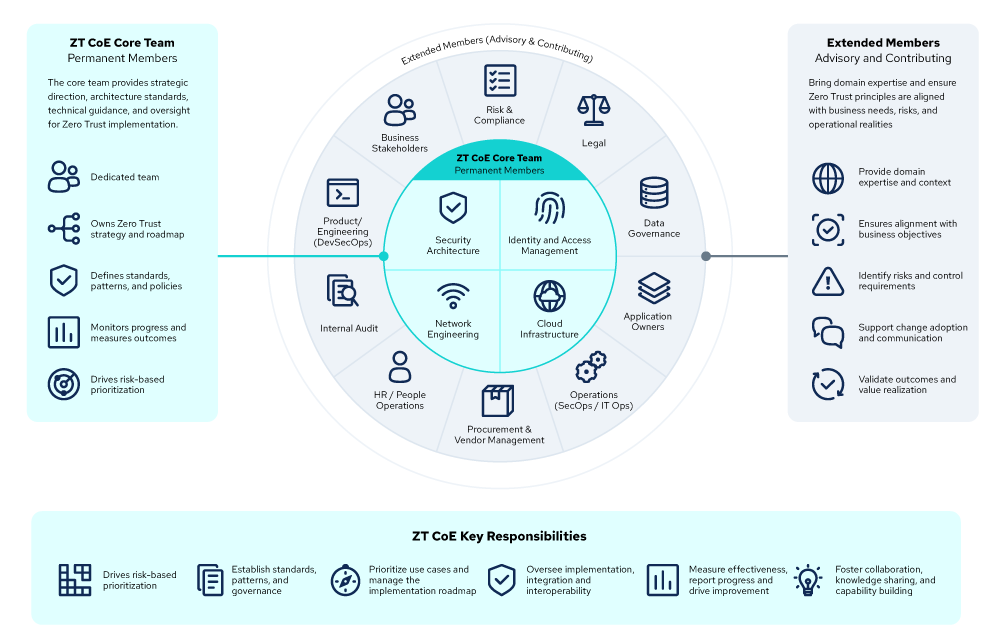
Figure 1: Zero Trust Center of Excellence Model
Beyond technical roles, successful ZT CoEs incorporate business-oriented positions. Risk management professionals help translate Zero Trust controls into risk reduction metrics that resonate with executives. Compliance specialists ensure implementations meet regulatory requirements while maintaining operational flexibility. A program management office function coordinates the numerous parallel workstreams, manages dependencies, and tracks progress against implementation roadmaps, maintaining a single view of status and risk for leadership.
The governance structure typically features an executive sponsor from either the CISO or CTO office who champions the initiative at the leadership level and secures necessary resources. This sponsor also makes key decisions on risk appetite and prioritization, ensuring Zero Trust efforts are grounded in business objectives rather than solely in technology concerns. A full-time program director manages day-to-day operations, while technical leads from each domain area provide subject matter expertise. Many organizations also establish an advisory board including business unit representatives to ensure Zero Trust initiatives align with operational needs, member and customer experience goals, and regulatory commitments.
Primary Responsibilities
The ZT CoE’s responsibilities span strategic planning through tactical execution. At the strategic level, the center develops and maintains the organization’s Zero Trust architecture blueprint, establishing the target state vision and creating the multi-year transformation roadmap. This includes defining Zero Trust principles specific to the organization’s context, risk tolerance, and regulatory environment using commonly accepted concepts such as “never trust, always verify,” “assume breach,” and “least privilege” as anchors.
The center serves as the primary technical authority for Zero Trust initiatives, establishing standards for technology selection, implementation patterns, and security controls. It develops and maintains the Zero Trust maturity model tailored to organizational needs, conducts regular assessments to measure progress, and identifies gaps requiring attention. Where possible, this model can be benchmarked against external frameworks such as the Cybersecurity and Infrastructure Security Agency (CISA) Zero Trust Maturity Model or the DoD Zero Trust Capability Roadmap to provide objective reference points. The CoE also manages the portfolio of Zero Trust projects, ensuring proper sequencing and resource allocation across initiatives, so foundational capabilities such as identity, data protection, and segmentation come online in a logical order.
From an operational perspective, the ZT CoE provides consultative services to project teams implementing Zero Trust capabilities. This includes reviewing architectural designs for alignment with Zero Trust principles, providing implementation guidance and best practices, and troubleshooting complex integration challenges. The center maintains a knowledge repository of lessons learned, reference architectures, and implementation playbooks that accelerate subsequent deployments, along with policy templates and training materials that can be reused across business units.
The CoE plays a crucial role in OCM, developing training programs for technical staff, creating awareness materials for general employees, and establishing Zero Trust champion networks across business units. It coordinates with human resources to update job descriptions and skill requirements, ensuring the organization builds necessary Zero Trust competencies and that expectations for secure behavior and control ownership are reflected in performance objectives.
Practical Implementation Considerations
Organizations should phase the ZT CoE establishment, beginning with a small core team of individuals who already serve in roles focused on security strategy and architecture before expanding to include broader representation. Depending on the size and complexity of the organization, Initial staffing might include 3–5 dedicated members supplemented by part-time participation from domain experts. As the program matures, the center typically grows as organizational complexity grows, with the mix gradually shifting from primarily strategic roles toward a balance of strategy, architecture, enablement, and operational support.
The CoE should establish clear metrics for measuring both its own effectiveness and Zero Trust implementation progress. These might include the percentage of critical assets protected by Zero Trust controls, mean time to detect and respond to security incidents, reduction in privileged access exposure, and improved compliance audit outcomes. Additional indicators, such as segmentation coverage for high-value systems, maturity scores by pillar, and the reuse rate of reference architectures, can help demonstrate value to leadership and regulators. Regular reporting to executive leadership maintains visibility and support for the transformation effort and creates a common language for discussing risk, investment, and progress.
Integration with existing governance structures requires careful consideration. The ZT CoE should complement, not duplicate, existing security and architecture review boards. Clear escalation paths and decision rights prevent conflicts while ensuring efficient progress. Many organizations find success by initially chartering the CoE as a time-bounded transformation initiative with defined milestones for transitioning responsibilities to operational teams, once Zero Trust controls and operating procedures are embedded into standard platforms and processes.
The DoD’s Zero Trust Reference Architecture includes specific guidance on governance structures and program management approaches that translate well to civilian organizations. Additionally, publications by the Cloud Security Alliance (CSA) about Zero Trust, particularly this document, offer practical step-by-step guidance and sample use cases.
Success ultimately depends on positioning the ZT CoE as an enabler rather than a gatekeeper, focusing on accelerating secure business outcomes while building sustainable Zero Trust capabilities across the enterprise. Over time, the CoE’s emphasis naturally shifts from initial design and rollout toward optimization, automation, and continuous improvement, ensuring the program remains aligned with evolving threats, technology, and regulatory expectations. Regular evolution of the center’s structure and responsibilities ensures continued relevance as the organization’s Zero Trust maturity advances.
Lasting Impact
By combining strong executive sponsorship, inclusive stakeholder engagement, and a formally chartered PMO, organizations ensure that Zero Trust is both strategically anchored and operationally executable. As an example, DoD’s ZT PfMO governance structure pairs a centralized body for direction and accountability with decentralized implementation across lines of business. The result is a sustainable Zero Trust program that adapts to evolving threats, meets regulatory expectations, and delivers measurable business value, rather than a one-time initiative that loses momentum once early projects are complete.
Building Effective Governance Structures
Effective Zero Trust cybersecurity governance needs to be established for pervasive and long-term organization impact and to enable organizations to remain adaptive for new risk profile changes like mandatory requirement updates, new business ventures, and mergers and acquisitions. Such efforts include:
- Organization-wide Zero Trust directive from top leadership, for a sustained priority
- Formal program charter defining the mission, scope, principles, and success measures
- Periodic executive steering committee or advisory board review meetings to review progress, address challenges, and set priorities
- Integration of Zero Trust KPIs into enterprise risk dashboards reviewed with leaders
The ZT PMO coordinates these structures, manages stakeholder engagement, and ensures alignment with strategic objectives.
Zero Trust is not a project to be completed but a sustained enterprise transformation. Building effective governance structures ensures that the program evolves iteratively, aligns with strategic objectives, and withstands the test of operational, regulatory, and cultural challenges. Without disciplined governance, Zero Trust risks becoming a fragmented IT exercise rather than an enterprise-wide strategic mandate.
Zero Trust and Regulatory Compliance
Zero Trust is not a subset of an organization’s compliance efforts, rather it is something that helps the organization achieve its compliance efforts by first establishing foundational standards and principles. In essence, ZT embodies core principles common to standards, frameworks, legislation, and regulation. By implementing these core principles within your ZT program, you avoid implementing a costly collection of disparate efforts for each of your compliance obligations.
Zero Trust significantly enhances an organization’s compliance effort by establishing a foundation that fulfills many of the requirements found in many security and control frameworks and standards, like ISO/IEC 27001, National Institute of Standards and Technology (NIST) CSF 2.0, NIST SP 800-53, and the CSA Cloud Controls Matrix (CCM). Across all these standards, risk management stands as a cornerstone, requiring continuous assessment and mitigation. Additionally, ZT control mappings should be operationalized through continuous control monitoring tooling, and not point-in-time Governance, Risk, and Compliance (GRC) attestations, all of which are foundational principles of Zero Trust. Organizations should leverage their GRC platforms to automatically map Zero Trust telemetry and controls to these various regulatory frameworks, streamlining audit reporting.
Identity and access management (IAM) represents a foundational concept of Zero Trust supporting compliance. Zero Trust’s core principle of “never trust, always verify” is paramount. Other supporting principles include:
- Concept of least privilege
- Segregation of duties (SoD)
- Concept of least functionality
- Continuous authentication
Individually and together these core principles directly reinforce the stringent access control and identity verification requirements common to standards and frameworks like ISO 27002, NIST SP 800-53’s Access Control (AC) and Identity and Authentication (IA) families, and CCM v4’s IAM domain, along with highly regarded controls like MFA and granular access policies. Zero Trust programs reduce the level of effort for all of your compliance efforts.
Continuous monitoring and logging are indispensable to ZT and found in almost all compliance requirements. ZTA’s operational model relies on constant vigilance over all access requests and data flows, which feeds directly into the detection capabilities emphasized by most standards and frameworks like NIST CSF 2.0 and the System and Information Integrity (SI) controls of NIST SP 800-53. This ongoing oversight enables organizations to identify deviations, respond to security incidents promptly, and demonstrate compliance through comprehensive audit trails while supporting all of your detection and response activities.
The “assume breach” mentality and segmentation principles also forms the basis for many compliance efforts. Policies and procedures are adaptable, offering implementation tiers and profiles (like those in NIST CSF 2.0 and NIST SP 800-53), enabling organizations to tailor their ZT governance and associated controls to their specific risk profiles and operational contexts.
ZT has the potential to provide the structure and security control capabilities necessary to help meet compliance requirements. Also, aligning ZT with compliance helps to increase the importance of a ZT strategy beyond simply reducing the likelihood of realizing a breach, while ensuring that ZTA is not just a technical implementation but also a well-managed and auditable security program.
Beyond strengthening compliance alignment, Zero Trust also serves as a unifying strategy that helps organizations rationalize and integrate their security and privacy obligations. CIS Controls, the HIPAA Security Rule, PCI DSS, SOX ITGCs, and emerging regulatory mandates such as CMMC often introduce overlapping requirements for access control, segmentation, data protection, monitoring, and risk governance. Zero Trust provides a single architectural and operational model that forms the foundation, reducing program redundancy and rework by eliminating the “framework fatigue” many organizations experience. Instead of running separate initiatives for PCI network segmentation, HIPAA access management, or CIS logging requirements, Zero Trust establishes a cohesive set of capabilities that satisfy multiple frameworks simultaneously. In doing so, Zero Trust becomes the connective tissue linking disparate compliance efforts, ensuring that regulatory requirements are met not as point-in-time checkboxes but as an integrated, continuously enforced security strategy that reduces operational friction and strengthens enterprise resilience.
Governance Principles
Effective Zero Trust governance is anchored on four principles:
-
Executive Priority: Zero Trust must be championed as a board-level and C-suite priority, with sustained sponsorship and accountability
-
Enterprise Alignment: Governance should integrate business, risk, compliance, and IT functions, ensuring ZT initiatives support mission objectives and regulatory obligations
-
Transparency and Accountability: Progress, risks, and resource use must be visible across leadership tiers, with decisions and outcomes tracked against agreed KPIs and maturity models
-
Continuous Adaptation: Governance must support ongoing refinement of the program, evolving with the threat landscape, business priorities, and regulatory mandates
Structural Elements of Governance
Drawing on the DoD’s ZT PfMO model and NSTAC guidance, enterprises should establish layered structures that provide both centralized direction and decentralized execution:
-
Program Charter: Defines the mission, scope, guiding principles, and expected outcomes. Anchors Zero Trust as a protected organizational priority, endorsed by the executive sponsor and board
-
Executive Steering Committee: Cross-functional senior leaders who review program progress quarterly, resolve resource conflicts, and set enterprise priorities
-
ZT PMO: A formal, chartered entity that oversees implementation across multiple lines of business. It coordinates projects, tracks KPIs, manages maturity assessments, and provides shared services (e.g., templates, architectures, training)
-
Line of Business Governance Forums: Localized committees or councils that ensure ZT controls are applied in a way that supports mission requirements while aligning to enterprise strategy
-
Center of Excellence (CoE): A pool of technical subject matter experts and architects who validate technologies, refine policies, and ensure consistency across domains and business units
Integrating Risk and Performance Oversight
Governance structures must embed Zero Trust directly into enterprise risk management and performance monitoring. This is achieved by:
-
Mapping Zero Trust KPIs and maturity scores into enterprise risk dashboards reviewed at board and executive levels
-
Linking ZT progress directly to business outcomes such as operational availability, compliance scores, and resilience benchmarks
-
Using maturity assessments (e.g., CISA ZTMM, NIST SP 800-207, DoD ZT Reference Architecture) as objective inputs for governance decisions
Governance Cadence
A disciplined cadence ensures sustained accountability:
-
Weekly: ZT PMO internal syncs to track issues, dependencies, and near-term milestones
-
Monthly: Reporting from business units and functional teams to the ZT PMO; dashboard and KPI updates
-
Quarterly: Steering committee and board updates; reprioritization of roadmap elements
-
Annually: Full Zero Trust maturity assessment, charter refresh, and program realignment to strategic goals
Outcome of Strong Governance
By embedding these structures, Zero Trust governance becomes more than oversight—it becomes an enabler. It provides the mechanisms to align technical initiatives with mission objectives, foster cross-functional collaboration, and sustain organizational momentum. Like the DoD ZT PfMO, enterprise governance ensures Zero Trust is not just deployed but operationalized, measured, and continually improved as a strategic advantage.
Engaging Business Owners and Stakeholders
Zero Trust is an inclusive architecture where ownership is shared across the enterprise using an enterprise-wide RACI framework. Participation from IT, Compliance, Risk, Operations, Legal, HR, Finance, Procurement, and other business units is essential. Because Zero Trust fundamentally changes how access, data, and workflows are governed, its success depends on aligning these stakeholders around clear roles, shared outcomes, and a common vocabulary for decision-making.
Effective engagement begins with translating Zero Trust into terms that resonate with each function. For Operations leaders, this may mean improved uptime and minimized blast radius during incidents. For HR, it can emphasize streamlined onboarding/offboarding and reduced insider-risk exposure. For Finance, it highlights cost avoidance by preventing breaches and enabling more predictable risk planning. For Legal and Compliance, it strengthens defensible controls and improves audit readiness. By framing Zero Trust as an enablement model rather than a technology mandate, leaders can more easily see how their contributions directly support enterprise priorities.
Connecting program goals like revenue protection, operational continuity, customer trust, and regulatory resilience to business outcomes helps each department recognize its role in Zero Trust. Highlighting early successes, such as reducing privileged access sprawl, securing a high-risk workflow, or improving audit findings, creates tangible proof points that encourage momentum and reinforce a proactive, shared-ownership security culture. Over time, consistent stakeholder engagement transforms Zero Trust from a security initiative into an organization-wide operating model that embeds security into every decision and process.
Executive Support
Executive sponsorship is proactive, driven by senior leaders who own the Zero Trust strategy, manage funding and policies, and make or endorse key decisions. They elevate ZT to a top board priority, connect investments to business continuity and competitiveness, and actively support governance frameworks like the ZT PMO. By publicly championing the program, evaluating progress against risk-based metrics, and ensuring steady funding, they keep priorities on track, maintain accountability, and deliver tangible results.
Program Scope, Charter, and Mandates
Establishing a clear mission statement, defined program scope, formal charter, and executive mandates provides the foundation for a successful Zero Trust program and helps embed Zero Trust as an enduring organizational culture. Together, these elements define the program’s purpose, objectives, governance, authority, and responsibilities while aligning stakeholders around a shared vision. They also provide the organizational commitment and accountability necessary to drive consistent decision-making, sustain long-term adoption, and ensure Zero Trust principles become integrated into everyday business and technology operations rather than remaining a standalone security initiative.
Mission Statement
Establish a unified, business-driven Zero Trust program that safeguards critical assets with encryption, dynamic granular access controls, and proactive, automated defenses. By verifying every request, enforcing least privilege, assuming breach, and leveraging predictive analytics to detect and respond to threats faster, often before impact, we strengthen resilience and ensure ongoing regulatory compliance.
Key Mandates
- Conduct annual Zero Trust maturity assessments
- Require strong authentication and device compliance for all vendors with critical access
- Establish milestones for identifying and securing high-value data flows
- Least privilege enforcement for all administrative and privileged accounts
The ZT PMO oversees these mandates, tracks compliance, and reports progress transparently to the executive sponsor and board.
Program Budgeting
Organizations should maximize the value of existing investments, resources, and capabilities wherever possible. However, implementing and sustaining a mature Zero Trust architecture often requires incremental investments in people, processes, and technology as capabilities evolve and organizational maturity increases.
The ZT PMO plays a critical role in identifying resource gaps, prioritizing investments, and helping organizations secure the funding necessary to achieve Zero Trust objectives. This includes partnering with business units and technology stakeholders to develop compelling business cases, quantify expected outcomes, demonstrate Return on Security Investment (ROSI), and align funding requests with measurable risk reduction and business priorities.
The ZT PMO should also continuously evaluate opportunities to optimize spending by consolidating overlapping capabilities, retiring legacy perimeter-centric security technologies, and reinvesting those savings into Zero Trust initiatives. By balancing the use of existing resources with strategic new investments, the ZT PMO can help ensure sustained executive sponsorship, financial support, and long-term program success.
Develop Program Roadmap
Zero Trust represents a focused cybersecurity strategic approach. Many enterprises already possess foundational capabilities that can serve as effective building blocks within a Zero Trust program. These elements, such as mature identity and access management processes, endpoint detection and response solutions, network segmentation practices, centralized logging, and vulnerability management programs, can be strategically leveraged to accelerate progress. Though they should not be considered mandatory prerequisites for Zero Trust adoption, they are important building blocks for establishing mature ZT programs. Zero Trust architectures can be implemented incrementally and aligned to an organization’s existing maturity and existing architecture. Quick wins are often realized where organizations enhance identity-centric controls (e.g., implementing adaptive MFA and least-privilege access), enforce device posture validation prior to granting access, tighten east-west traffic inspection between workloads, and automate policy enforcement through existing governance and orchestration platforms, which all deliver immediate risk reduction and visible improvements in security posture without requiring wholesale transformation.
Quick Wins (First 12 Months)
- Complete enterprise-wide asset and data inventory: Build a trusted source for identifying and protecting high-value assets
- Expand authentication beyond MFA: Require MFA plus conditional access, device compliance, and phishing-resistant authenticators
- Implement basic micro-segmentation: Limit lateral movement in priority network and cloud segments
- Encrypt sensitive data at rest and in transit: Prioritize high-value data and critical communications
- Establish centralized logging and visibility: Aggregate telemetry into Security Information and Event Management (SIEM)/Security Orchestration, Automation, and Response (SOAR) for faster detection and coordinated response. Advanced organizations might seek to leverage AI-enabled or identity-aware logging solutions for faster anomaly detection
- Launch role-based Zero Trust training: Equip all personnel with knowledge of their role in ZT
- Kick off governance cadence: Hold the first steering committee session and publish the initial KPI dashboard
Long-Term Focus Areas
- Deploy context-aware access controls enterprise-wide: Extend adaptive, risk-based enforcement across all systems and environments, including third-party access
- Continuously track maturity with business-aligned metrics: Maintain a unified Zero Trust scorecard; benchmark against NIST/CISA maturity models
- Automate threat detection and adaptive response: Leverage analytics, AI, and orchestration to reduce mean time to detect/respond (MTTD/MTTR) and evolve defenses with emerging threats
Roles and Responsibilities
Within Zero Trust program management, clearly defined roles and responsibilities are critical to establishing governance, driving execution, and maintaining strategic alignment across the enterprise. Program leadership must be accountable for defining the Zero Trust roadmap, prioritizing initiatives, coordinating cross-functional stakeholders, and measuring progress against maturity and risk-reduction objectives, while designated owners for identity, device, network, data, and application domains ensure consistent policy design, integration, and operational oversight. This structured assignment of responsibility enables disciplined execution, prevents fragmented implementations, and ensures Zero Trust principles are sustained as an enterprise-wide operating model rather than a collection of isolated controls.
-
Executive Sponsor/CISO: Strategic oversight, funding authority, program-to-business alignment, board engagement
-
ZT PMO Director: Governance, program management, KPI tracking, cross-functional coordination
-
CoE Director: Program oversight, standards champion, enablement leader
-
Domain Architects (Identity, Endpoint, Network, Data, App): Design, integrate, and maintain specific Zero Trust capabilities within their technology pillars
-
Technical and Compliance Teams: Implement, monitor, and enforce daily ZT controls
-
Business Units: Classify and safeguard data assets within the Zero Trust model
-
Steering Committee: Oversight, prioritization, executive reporting, decision escalation
Zero Trust success demands enduring governance, leadership commitment, and organization-wide participation. A formally established ZT PMO, supported by empowered, active executive sponsorship, ensures the initiative is cohesive, measurable, and sustained for lasting impact.
Zero Trust Maturity Assessment
To effectively measure progress and outcomes, organizations should adopt a Zero Trust maturity assessment framework anchored in the five-step methodology defined by the NSTAC Zero Trust and Trusted Identity Management Report. This model provides a structured approach for designing, implementing, and continuously improving a Zero Trust architecture through the following stages:
- Define the Protect Surface
- Map Transaction Flows
- Architect the Zero Trust Environment
- Create Policy and Enforcement Mechanisms
- Monitor, Measure, and Maintain
Organizations should evaluate Zero Trust maturity by assessing the implementation and effectiveness of Zero Trust principles, processes, and technologies across each stage of the model. This approach aligns with the NSTAC framework while incorporating guidance from NIST, CISA, the DoD, Microsoft, and other recognized Zero Trust frameworks.
A Zero Trust maturity assessment should evaluate the degree to which Zero Trust capabilities have been established, integrated, and operationalized across the enterprise. Areas of assessment may include governance, IAM, network segmentation, device security, data protection, visibility and analytics, automation, and policy enforcement.
Maturity assessments should consider both the breadth of capability deployment and the consistency of operational execution. Organizations should assess whether Zero Trust controls are formally defined, implemented across the enterprise, integrated with other security functions, and continuously monitored and improved.
The objective of the assessment is to identify strengths, gaps, and opportunities for improvement while providing a measurable roadmap for advancing Zero Trust maturity over time. By performing periodic assessments, organizations can track progress, prioritize investments, and ensure that Zero Trust capabilities continue to evolve alongside business requirements and emerging threats.
Maturity Models
Examples of existing maturity models include:
-
CISA Zero Trust Maturity Model (ZTMM), including Microsoft Extensions: Outlines a staged progression across identity, device, network, application, and data pillars from “Traditional” to “Optimal” maturity
-
DoD Zero Trust Reference Architecture and Strategy: Adds operational detail for large, regulated enterprises
-
Forrester and Gartner Maturity Models: Focus on pragmatism, risk-based prioritization, and program governance
By integrating these models with CSA’s practical toolkits, organizations can develop risk-prioritized, business-aligned roadmaps and continuously benchmark Zero Trust progress both across and within pillars, in traditional, cloud, and hybrid ecosystems. For example, during vendor procurement, the ZT PMO can leverage the CSA Cloud Controls Matrix (CCM) to assess a prospective vendor’s security controls, validate alignment with Zero Trust principles, identify control gaps, and inform risk-based purchasing decisions. Many resources exist to support this process, such as the Numberline Zero Trust Maturity Model Resource Center and the CISA ZTMM, which provides structured progression criteria aligned to the pillars of Data, Applications and Workloads, Devices, Network, and Identity.
These models reinforce that a Zero Trust journey must begin with a precise inventory cataloging the protect surface, which feeds directly into maturity‑level assessments and governance.
Assessment Section – Protect Surface First
A Zero Trust journey must begin with a precise inventory cataloging the protect surface. This encompasses not just traditional IT assets but all data, applications, assets, and services (DAAS) central to business operations and regulatory risk posture. To align with CSA and CISA‑style maturity models, this assessment should be explicitly mapped to each pillar and its maturity levels (Traditional → Initial → Advanced → Optimal), with inventories treated as baseline evidence for achieving higher maturity.
-
Data: Inventory, classify, and tag all sensitive data types (e.g., personal health information (PHI), personal identifiable information (PII), claims, financial records, IP address), and track storage and flow patterns (e.g., on‑premises, cloud, B2B, SaaS) and who/what accesses or processes each dataset. For each data category, research:
- Whether automated discovery and classification tools are in place, as required at the “Initial” and higher ZTMM maturity levels
- Whether data‑movement workflows (e.g., APIs, ETL, SaaS integrations, B2B feeds) are mapped, monitored, and subject to Zero Trust‑compatible analytics and policy enforcement
-
Applications: Document all business‑critical, regulatory, and customer‑facing apps (e.g., custom, COTS, SaaS, cloud‑native), dependencies, owners, and APIs/integrations. For each application, research:
- Whether the application is tracked in a unified catalog that links to ownership, risk level, and regulatory scope (e.g., HIPAA, PCI‑DSS, GDPR)
- Whether application‑level least‑privilege controls (role‑based, attribute‑based, or context‑aware policies) are enforced consistently across cloud, on‑prem, and hybrid environments, as expected in advanced ZTMM maturity tiers
-
Assets: Maintain a real-time registry of endpoints, servers, IoT/OT, medical equipment, and cloud virtual machines (VMs)/containers, including security state, management, and ownership. When assessing assets, explicitly examine:
- Whether the asset inventory includes health signals such as patch level, configuration status, and endpoint detection and response (EDR) posture, and whether these signals feed into policy decisions (e.g., step‑up verification or conditional access)
- Whether all asset types (including IoT, OT, and medical devices) are mapped against the ZTMM pillars, Devices and Applications and Workloads, and how visibility and policy enforcement are implemented across them
-
Services: List and review authentication/directory, cloud storage, B2B gateways, EHR, and all third-party providers. For each service, research:
- Whether identity and access services (e.g., directory, single sign-on (SSO), MFA) are treated as core Zero Trust enablers and are integrated into end‑to‑end policy enforcement for all protect‑surface components
- Whether third‑party and SaaS providers are assessed against the organization’s Zero Trust and maturity‑model expectations (especially for Data and Applications and Workloads), and how they are represented in the risk‑prioritized roadmap
In addition, extend each protect‑surface category by mapping transaction flows (e.g., user, device, and service identities) and network paths, then tie these to the three CSA/CISA cross‑cutting capabilities: Visibility and Analytics, Automation and Orchestration, and Governance, ensuring that the protect‑surface inventory directly feeds into maturity‑level evidence and continuous benchmarking.
Assessing Maturity Across the Lifecycle
A robust Zero Trust maturity assessment is an ongoing process that drives continuous improvement and alignment to both business goals and regulatory requirements. The assessment framework addresses the who, when, how, and what to do next, ensuring that progress is measured, gaps are surfaced, and actions are targeted.
What to Assess
Zero Trust maturity assessment is enterprise-wide and cross-disciplinary, not a one-time, siloed event.
-
Assess at multiple levels: organization-wide, as well as each relevant business and technical domain (e.g., systems, applications, data flows, networks, and operational units).
-
Protect Surface - Include all Zero Trust pillars: User/Identity, Devices, Applications and Workloads, Data, Network/Environment, Automation and Orchestration, Visibility and Analytics, and Governance
What to Assess Against
Review the available models and to select the applicable one(s) for your organization.
When to Assess
Identify the appropriate assessment time-frame and level for your organization.
-
Organization Level: Enterprise-level capabilities and organizational readiness
-
Baseline/Current State: Before transformation begins, establish a baseline maturity and compliance state using recognized frameworks
-
Targets: Set your target maturity
-
Post-Implementation: Reassess after each significant implementation phase to measure impact, identify residual risk, and update compliance status
-
Annual (or Event-Driven): Conduct a full reassessment at least annually or when triggered by regulatory changes, business realignments, mergers, or major security events
How to Assess
Identify the reference models and methods by which your organization will perform its assessment.
-
Models: Use authoritative benchmarks such as the CISA Zero Trust Maturity Model (ZTMM), NIST SP 800-207, the DoD Zero Trust Reference Architecture, Forrester, or Gartner maturity models
- Criteria and Metrics: Evaluate each pillar with clearly defined, objective metrics. For example:
- Policy coverage (existence and scope of controls)
- Percent of assets managed and inventoried
- MFA coverage for users and vendors
- Data classification and encryption rates
- Network segmentation depth and enforcement
- Degree of automation in response, compliance, and logging
- Audit completeness and frequency
- Incident response efficacy and timeliness
-
Methods: Gather data quantitatively (e.g., technical inventories, tool statistics, logging, audits) and qualitatively (e.g., interviews, surveys, tabletop exercises, operational reviews)
- Scoring and Visualization: Use dashboards, heatmaps, or scorecards to present progress, trends, and pillar-specific gaps in ways that are directly actionable by business and technical leaders
What to Do With Results
Use your organization’s results to inform the following efforts.
-
Gap and Risk Analysis: Compare each pillar’s current state with its target maturity, mapping deficiencies to specific business and regulatory risks
-
Prioritization: Identify and rank areas posing the greatest exposure or offering the most value for rapid improvement, directly informing roadmap updates
-
Action and Reporting: Use assessment outcomes to update the Zero Trust implementation roadmap, refine KPIs, and report progress transparently to executive and board stakeholders
-
Continuous Improvement: Reassess at defined intervals, measure the effect of improvements, and refresh priorities in response to new threats, requirements, or lessons learned
| Assessment Dimension | Key Actions |
|---|---|
| Who/What | All business/technical domains, each Zero Trust pillar |
| When | Baseline, post-implementation, annually, or upon major change/event |
| How | Authoritative frameworks, quantitative and qualitative evidence, scored/executive dashboards |
| What Next | Gap analysis, prioritization, roadmap/budget updates, transparent executive reporting |
Table 2: Zero Trust Maturity Assessment at a Glance
This approach transforms the maturity assessment from an isolated audit into a core driver of effective, business-aligned Zero Trust program management, ensuring ongoing relevance, regulatory alignment, and measurable risk reduction.
Execute and Review Roadmap
Use assessment findings to develop a prioritized, risk-driven, and milestone-based roadmap that aligns with executive oversight and regulatory reporting cycles.
| Year | Key Maturity Initiatives | Owner | Success Metrics |
|---|---|---|---|
| 1 | Asset/data inventory, expand MFA, ZT training, 24x7 logging | IT/Security | 100% inventory, full MFA, staff trained |
| 2 | Zero Trust Network Access (ZTNA) for remote/third parties, segment critical | Network | 90% ZTNA for remote, plan in place |
| 3 | SOAR/User and Entity Behavioral Analytics (UEBA), extended micro-segmentation, policy automation, adaptive IR/response | SecOps | 75% segmented, advanced SOAR policy coverage, MTTR reduction |
| 4 | Target maturity, tabletop exercises | All | 90%+ at target, incident rehearsal |
Table 3: Example Roadmap
Continuous Improvement
Zero Trust maturity is never finished. Mature organizations institutionalize:
- Annual or event-driven reassessment
- Simulations (e.g., purple teams, table-tops) and penetration testing
- Systematic response to audit/compliance findings and real incidents
The integration of these practices, with a relentless focus on the protect surface and alignment to international and sectoral regulatory frameworks, as well as the use of data-driven KPIs and periodic reviews, ensures Zero Trust delivers measurable, business-aligned, and regulatorily compliant cyber resilience.
Five-Step Implementation Process – From Theory to Practice
This systematic approach converts protect surface concepts into operational reality, utilizing a proven methodology refined through extensive enterprise implementations and validated by measurable business outcomes.
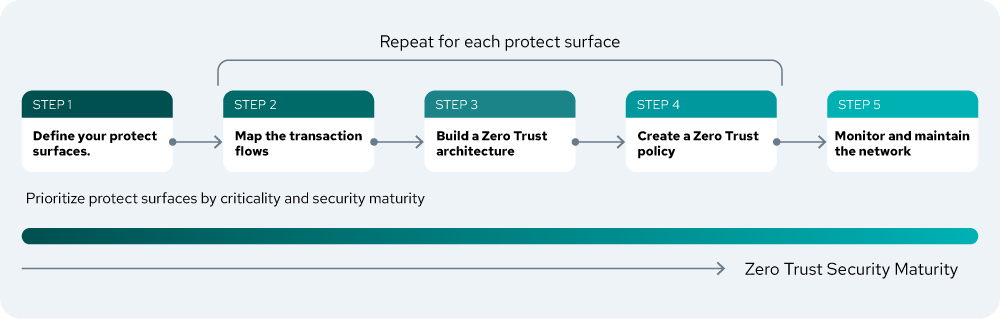
Figure 2: Zero Trust Five-Step Implementation Process
Step 1: Define the Protect Surface – Foundation for Focused Implementation
Before beginning Step 1, the organization must establish foundational governance and executive commitment. Upon completion, a comprehensive protect surface definition enables progression to detailed transaction flow analysis in Step 2.
Entry criteria to confirm organizational readiness:
- Executive charter signed with resource commitment
- Steering committee established
- Initial budget allocation (35% for data identification)
- Preliminary system inventory started
Step-by-step process to lay the foundation for implementation:
-
Implementation Objective: Identify and prioritize the organization’s most critical business systems and DAAS elements to establish focused implementation boundaries, concentrating resources for maximum effectiveness. See Defining the Zero Trust Protect Surface from the CSA for additional guidance.
-
Systematic DAAS Discovery Process: Execute a structured and repeatable process to identify DAAS that define the organization’s protect surface, aligned with NIST SP 800-207. Leverage automated discovery and inventory tools, supplemented by stakeholder validation, to ensure accuracy and completeness.
- Prioritize high-value resources based on business risk, rather than attempting to catalog all assets equally. Examples include intellectual property, customer data, financial systems, and regulated information. This approach establishes a focused set of critical resources to be protected through policy enforcement, continuous monitoring, and dynamic access controls.
- The protect surface should be continuously maintained and refined to reflect changes in business operations, technology, and the evolving threat landscape.
-
Business Impact Analysis Implementation: Conduct a thorough business impact analysis to measure the potential effects of a compromise, including direct financial costs, regulatory penalties, operational disruptions, reputational harm, and strategic significance. This analysis helps prioritize efforts based on data, focusing on the elements with the highest risk exposure.
-
Crown Jewels Identification Process: From a comprehensive DAAS inventory, systematically identify crown jewels—assets whose compromise would cause disproportionate harm. Use established criteria, including business criticality, data sensitivity, operational dependencies, regulatory importance, and recovery complexity, to set implementation priorities.
-
Implementation Success Criteria: Achieve identification and classification of all business critical DAAS elements, with documented exception handling for unmanaged, ephemeral, or shadow assets discovered during operation. Distinguish between the persistent protect surface (cataloged assets with assigned owners) and the dynamic protect surface (workload identity, attestation, and runtime policy) for cloud-native environments where static inventory is not achievable. Allocate 35% of initial implementation effort to data identification and classification, establishing the foundation for all subsequent Zero Trust controls.
-
Resource Allocation Strategy: Concentrate initial efforts on data-centric controls (35%), then address critical business applications (30%), supporting infrastructure assets (25%), and enabling services (10%).
Exit criteria to validate achievement of objectives:
- 100% DAAS identification and classification completed
- Protect surface boundaries clearly defined and approved
- Business Impact Analysis completed for all critical elements
- Gap assessment completed against NIST/CISA benchmarks
- All stakeholder approvals obtained
Step 2: Map the Transaction Flows - Understanding Implementation Impact
Flow mapping readiness and validation for Step 2 builds directly on the protect surface definition from Step 1. Detailed transaction flow mapping requires validated DAAS inventory and active stakeholder engagement. Upon completion, comprehensive flow documentation provides the foundation for architectural design in Step 3.
Entry criteria to confirm organizational readiness:
- Step 1 exit criteria fully met, including complete DAAS inventory
- SIEM and network monitoring tools are operational
- Business process owners identified and available
Step-by-step process to map transaction flows and understand implementation impact:
-
Implementation Objective: Document how users, applications, and systems interact with each DAAS element to enable surgical Zero Trust control implementation that minimizes operational disruption while maximizing security effectiveness.
-
Systematic Kipling Method Application: Address six critical questions for each protect surface element using established assessment frameworks:
- Who accesses the DAAS (e.g., internal users, contractors, third parties, service accounts)?
- What resources do they access (e.g., specific data, applications, services)?
- When does access occur (e.g., time patterns, business cycles, anomalies)?
- Where does access originate (e.g., locations, devices, networks)?
- Why is access justified (e.g., business purpose, job function, process requirements)?
- How is access performed (e.g., protocols, authentication methods, encryption)?
-
Dependency Risk Assessment Implementation: Map technical and business dependencies using established risk management frameworks, focusing on understanding how DAAS element interdependencies affect implementation sequencing and risk mitigation.
-
Workflow Optimization Integration: Identify business process improvement opportunities using established operational excellence frameworks, ensuring Zero Trust implementation enhancements deliver operational value aligned with business objectives.
-
Implementation Success Criteria: Complete transaction flow documentation enabling targeted Zero Trust control placement that minimizes business disruption while achieving security objectives. This detailed understanding proves essential for maintaining business operations during implementation phases.
Exit criteria to validate completions of step objectives:
- Transaction flow documentation is complete for 100% of critical DAAS
- Kipling Method (Who/What/When/Where/Why/How) answered for each element
- Technical and business dependencies mapped
- Threat models developed for high-priority applications
- Business owner validation obtained
Step 3: Architect a Zero Trust Network – Focused Technical Implementation
Architecture readiness and pilot validation for Step 3 translates documented flows into operational security architecture. A successful transition requires validated flows and a technology platform selection. A pilot deployment validates the architectural design before enterprise-scale deployment in Step 4.
Entry criteria to ensure technical readiness:
- Step 2 exit criteria fully met
- Validated transaction flows available
- Technology platform selection completed
- Pilot scope defined
- 40% of budget allocated for technology
Step-by-step process for a focused technical implementation:
-
Implementation Objective: Design and implement granular security boundaries around each DAAS element using micro-segmentation that moves with data and applications regardless of location.
-
Micro-Perimeter Implementation Strategy: Create security boundaries around each DAAS element using established network and environment frameworks integrated with cloud and hybrid environment capabilities. Unlike traditional network perimeters, these micro-perimeters provide focused protection that adapts to business requirements.
-
Architecture Principles Implementation: Enforce “never trust, always verify” through continuous authentication and authorization for all DAAS access using established IAM frameworks. Deploy least privilege access using minimum necessary access controls aligned with role-based access requirements. Design “assumes breach” controls, assuming the presence of an attacker, and utilizes established incident response frameworks. Implement continuous monitoring through comprehensive logging and analysis using established visibility and analytics capabilities.
-
Technology Stack Integration: Deploy comprehensive security technologies, including enhanced IAM, MFA, EDR, SIEM, Data Loss Prevention (DLP), Cloud Access Security Broker (CASB), and ZTNA/Secure Access Service Edge (SASE) with a specific focus on DAAS protection rather than comprehensive coverage.
-
Implementation Success Criteria: Achieve a Zero Trust architecture with operational uptime greater than 95% and a productivity impact of less than 10%. Allocate 40% of the program budget to technology platforms and integration while maintaining focus on protect surface elements.
Exit criteria to ensure operational viability of the Zero Trust architecture:
- Zero Trust architecture designed and documented
- Micro-perimeters operational for pilot DAAS elements
- IAM/MFA deployed for pilot scope
- SIEM integration is complete with monitoring operational
- 95% uptime achieved
- <10% productivity impact validated
- Pilot successfully deployed
Architectural Guidance
The following resources may prove useful during implementation of a Zero Trust architecture:
-
NIST SP 1800-35: Offers practical, step-by-step examples of Zero Trust implementations, with demonstrations and measurement techniques for real-world environments
-
NIST SP 800-207: Provides the core architectural guidelines, emphasizing iterative adoption and policy automation
- NIST SP 800-207A: Provides Zero Trust architecture guidance specific to multi-cloud and hybrid environments, including identity federation patterns and policy decision point placement across trust boundaries
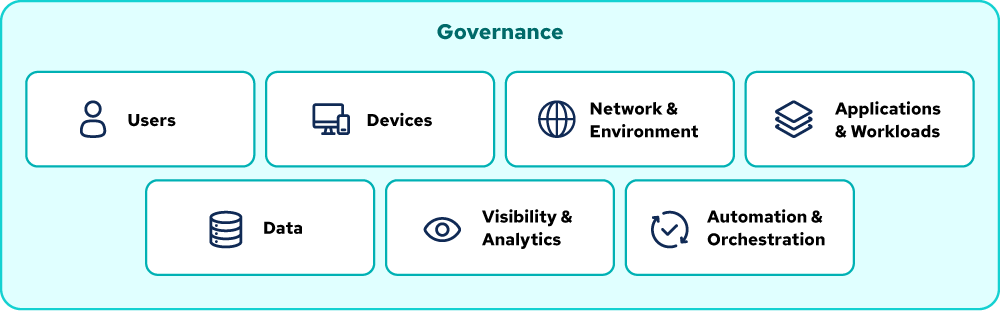
Figure 3: Pillars of Zero Trust
A mature Zero Trust program addresses every avenue of attack, from user identity to cloud workloads, by building security around the following pillars. Rather than starting from scratch, organizations should build existing investments and foundational controls using these pillars as a framework to assess, enhance, and modernize security architectures.
Adapt each pillar to make it relevant for your business environment, ensuring alignment with both current operations and future risk landscapes. These pillars form the organizing structure for controls, monitoring, and governance.
| Pillar | What It Means/Focus | Key Capabilities and Controls |
|---|---|---|
| User/Identity | Identity, authentication, access | IAM, MFA, PAM, role-based access control (RBAC), user monitoring, user training |
| Devices | Endpoint security, inventory | Asset/IoT/inventory, device health, EDR/XDR, Unified Endpoint Management (UEM) and Mobile Device Management (MDM) |
| Applications and Workloads | Secure apps/services, assurance | Secure Software Development Life Cycle (SDLC), inventory, API security, patching, containers, workload identity |
| Data | End-to-end protection | Classification, DLP, encryption, tagging, monitoring, masking |
| Network/ Environment | Segmentation and network controls | Micro-/macro-segmentation, ZTNA, Network Access Control (NAC), Software-Defined Networking (SDN), logging |
| Automation and Orchestration | Automated enforcement/response (enabler) | SOAR, playbooks, policy automation, AI/Machine Learning (ML) |
| Visibility and Analytics | Continuous monitoring, detection (enabler) | SIEM, UEBA, dashboards, audit logs, forensic analysis |
Table 4: Pillars of Zero Trust
Step 4: Create Zero Trust Policy – Zero Trust Implementation
Policy readiness and production authorization for Step 4 operationalizes Zero Trust through comprehensive policy governance. A successful pilot from Step 3 provides the operational baseline for policy development. Upon completion, production authorization enables deployment and continuous monitoring in Step 5.
Entry criteria to confirm production readiness:
- Step 3 exit criteria fully met
- Successful pilot deployment completed
- Architecture operational and validated
- Testing environment available
- Change management processes established
Step-by-step process for implementing Zero Trust:
-
Implementation Objective: Establish a comprehensive framework that operationalizes Zero Trust principles through enforceable policies, supporting business operations while maintaining strict security controls.
-
Policy Framework Development Process: Create comprehensive technical policies using a systematic Kipling Method approach, focusing on operational implementation and user experience. Ensure policies are enforceable, auditable, and aligned with business requirements using established governance and quality assurance frameworks.
-
Dynamic Policy Engine Implementation: Deploy policy engines capable of real-time decision-making based on contextual factors, including user behavior, device compliance, location, and risk assessment for DAAS access. Integrate with established monitoring and analytics capabilities to enable adaptive response.
-
Go-Live Authorization Framework: Establish comprehensive testing and authorization processes that validate key principles, including minimum blast radius, deny-all/permit-by-exception, and comprehensive visibility. Focus on implementation testing that validates both security effectiveness and operational requirements.
-
Implementation Success Criteria: Achieve comprehensive policies operational with successful deny-all/permit-by-exception implementation and a less than 2% false positive rate. Integrate policies with established governance oversight and steering committee frameworks to ensure sustained effectiveness.
Exit criteria to validate policy completeness:
- Comprehensive policies documented and approved
- Deny-all/permit-by-exception implemented
- <2% false positive rate achieved
- Minimum blast radius validated through testing
- 100% logging of policy decisions operational
- All testing phases completed successfully (functional, integration, user acceptance testing, security)
- Authorization to Operate (ATO) signed by Authorizing Official (AO)
- Backout procedures tested and validated
Production Readiness Validation and Release Authorization
Release management is a process for planning, building, testing, and deploying new or updated IT services into production. The primary objective of release management is to minimize disruptions and to manage risk. IT does this by ensuring changes are introduced in a controlled and efficient manner to maintain the stability and quality.
Prior to going live (i.e., promoting into production), different forms of validation are performed to verify the system meets business and operational requirements while ensuring no outstanding issues exist that would cause unacceptable operational issues. Testing in different forms is the most common form of validation (e.g., functional, performance, security, end-to-end, acceptance). Commercial environments handle testing as part of the development process and as part of operations. Readiness validation and release authorization occur after development but prior to being accepted and promoted into production. ITIL 4 has the most widely used set of practices for additional reference. Outstanding issues identified are either resolved prior to being promoted into production or accepted by an informed authoritative source.
Organizations, especially more mature organizations, require a formal declaration before being promoted into production. In commercial environments, the authoritative source is a business executive. Government organizations often require a formal declaration known as an Authorization to Operate, or ATO. ATOs can only be issued by an Authorizing Official, or AO, designated by a legal authority to permit a system to be promoted into production.
It is best practice to rely on an agreed upon set of information security controls. The authorization typically does not require all requirements to have been met. It is up to the designated authority’s discretion based on established guidelines. The designated authority may make an informed decision to accept residual risk based on operational need within the established guideline. When this occurs, the acceptance is often bounded in time and often requires compensating controls like limiting the use until residual issues are resolved to the designated authority’s satisfaction.
As a best practice, organizations should incorporate tested backout procedures, feature flags, and, where appropriate, kill switch capabilities into their Zero Trust release management processes. Backout procedures should be validated in a pre-production environment prior to deployment rather than assumed effective based solely on documentation. Because Zero Trust policy changes often span multiple control layers, including identity, network, device, application, and workload enforcement, a failed deployment can create cascading disruptions across dependent systems if recovery mechanisms have not been thoroughly exercised. To reduce operational risk, release authorization should require documented evidence of successful rollback testing as a deployment gating criterion, ensuring that recovery capabilities are proven before changes are introduced into production environments.
Feature flags, sometimes referred to as feature toggles, provide an additional layer of operational flexibility by enabling or disabling functionality at runtime without requiring code changes or redeployment. These capabilities support phased rollouts, controlled testing, rapid mitigation of defects, and the selective activation or deactivation of Zero Trust controls while minimizing business disruption.
Backout procedures are intended to restore a previously known-good operational state when a deployment or policy change produces unintended consequences. In situations where rapid containment is required, organizations may also implement kill switch capabilities that can immediately disable a system, service, model, or specific functionality. While historically less common, kill switches are becoming increasingly important as organizations adopt AI-enabled and autonomous systems, where the ability to quickly halt operations may be necessary to address safety, security, compliance, or operational concerns. As a result, kill switch capabilities are now included in several emerging national and international standards governing higher-risk technologies.
Together, backout procedures, feature flags, and kill switches provide complementary safeguards that enhance resilience, reduce operational risk, and support the safe adoption and ongoing evolution of Zero Trust architectures.
Step 5: Monitor and Maintain – Sustained Implementation Excellence
Operational readiness and continuous improvement in Step 5 establishes continuous monitoring, measurement, and improvement as permanent organizational capabilities. Production authorization from Step 4 enables operational deployment. Ongoing quarterly assessments validate sustained effectiveness and drive continuous optimization.
Entry criteria to confirm operational readiness:
- Step 4 exit criteria fully met
- Production authorization obtained
- Policies operational in production
- Monitoring tools are fully operational
- 24/7 operations capability established
- Incident response procedures tested
Step-by-step process to sustain implementation excellence:
-
Implementation Objective: Ensure ongoing effectiveness through continuous monitoring and improvement that validates protect surface protection while enabling business operations.
-
DAAS Protection Validation Process: Implement comprehensive monitoring specifically focused on DAAS elements within the protect surface using established visibility and analytics methodologies. Ensure that the most critical assets receive the appropriate attention and resources aligned with governance oversight.
-
Blast Radius Validation Implementation: Through transaction flow mapping and continuous monitoring, validate that blast radius remains minimized and contained. Use this process to ensure Zero Trust implementation maintains security boundaries while enabling business operations aligned with operational excellence frameworks.
-
Implementation Success Criteria: Achieve comprehensive monitoring operational with measurable security improvements exceeding 60% incident reduction and clear business value demonstration. Utilize established maturity frameworks, including CISA ZTMM and NIST SP 800-207, for regular assessment and validation of sustained effectiveness.
Exit criteria to validate operational excellence and business value delivery (ongoing, quarterly validation):
- 100% of critical DAAS elements monitored
- 60% reduction in security incidents achieved
- 50% improvement in MTTD and MTTR demonstrated
- 95% regulatory compliance maintained
- Quarterly maturity assessments completed
- Annual audits passed
- Continuous improvement documented
- 200% ROI achieved within 24 months
- 90% user adoption maintained
Continuous Monitoring Framework
Effective Zero Trust operations depend on comprehensive, continuous monitoring that validates protection measures while enabling business operations. Organizations should maintain a real-time inventory of all DAAS elements through automated discovery and Configuration Management Database (CMDB) integration, supported by regular validation processes to ensure asset completeness and accurate criticality classifications.
Comprehensive logging and monitoring should be implemented across all DAAS access activities. Strong authentication mechanisms should be enforced for human identities, while non-human identities should leverage secure, short-lived credentials. Automated monitoring capabilities should identify unauthorized access attempts, validate compliance with approved data movement patterns, and detect anomalous activity across users, systems, applications, and data flows.
Continuous monitoring should also extend to network segmentation controls to verify the effectiveness of containment strategies and detect unauthorized lateral movement attempts. Security operations capabilities should support rapid threat detection, investigation, response, and containment while ensuring timely communication with executive stakeholders when significant incidents occur.
Compliance monitoring should provide ongoing visibility into adherence with applicable regulatory, contractual, and organizational requirements. Organizations should maintain audit-ready documentation and establish structured processes for identifying, tracking, and remediating control gaps.
Finally, Zero Trust monitoring programs should balance security effectiveness with operational performance. Organizations should continuously evaluate the impact of security controls on system availability, user experience, and productivity while minimizing alert fatigue through effective tuning and continuous improvement of detection capabilities. The table below includes some metrics to consider.
| Category | Metric | Target |
|---|---|---|
| Asset Visibility | DAAS inventory coverage | >95% of DAAS assets discovered and tracked |
| Asset Management | Asset inventory validation | Weekly validation cycle |
| Identity Security | Unauthorized access detection | Within 15 minutes |
| Transaction Monitoring | Approved transaction flow monitoring coverage | >90% of mapped transaction flows continuously monitored |
| Transaction Monitoring | Anomalous data movement detection | Within 30 minutes |
| Network Security | Unauthorized lateral movement prevention | >95% blocked |
| Incident Detection | MTTD | <4 hours (target), <2 hours (aspirational) |
| Incident Response | MTTR | <2 hours |
| Incident Containment | Containment of critical incidents | Within 30 minutes |
| Executive Communications | Executive notification of critical incidents | Within 15 minutes |
| Compliance | Regulatory compliance adherence | >95% compliance across applicable requirements |
| Audit Readiness | Audit-ready documentation availability | Within 24 hours |
| Remediation | Compliance gap remediation | Within 30 days |
| Service Availability | Critical DAAS uptime | >99.9% |
| User Experience | Security control performance impact | <10% degradation |
| User Productivity | Productivity impact from security controls | <5% |
| Security Operations | False positive alert rate | <2% |
Table 5: Zero Trust Metrics
Incident Detection and Response
Effective incident detection and response programs contain several core capabilities that when integrated properly, can result in a very effective defensive security posture. Automated threat detection capabilities are often anchored by a comprehensive logging and monitoring platform, such as a SIEM. These platforms can provide significant control coverage by monitoring and alerting the environment 24/7/365. UEBA establishes baseline user and entity behavior patterns, automatically identifying anomalies indicating potential compromise. Specific threat intelligence feeds integrate current information about threats targeting organizations, enabling real-time correlation of internal security events with known attack patterns.
SOAR platforms execute automated incident response playbooks with >95% successful execution rates. Automation reduces response time to <5 minutes. Automated containment procedures immediately isolate affected systems, suspend compromised accounts, and activate segmentation controls while maintaining critical operations through failover mechanisms.
Evidence collection and forensics capabilities maintain immutable audit trails with cryptographic verification supporting forensic investigations and regulatory compliance. Organizations must maintain comprehensive retention for regulatory requirements. Quarterly backup restoration testing validates malware-free recovery capability with <72-hour full recovery timeframe for ransomware scenarios. Post-incident review procedures conducted within 7 days systematically integrate lessons learned into improved detection rules and response procedures.
Supporting Security Services
Comprehensive security services integrate to provide visibility, control, and automation across all technology environments. SIEM platform deployment aggregates security events from endpoints, networks, cloud services, and applications. Real-time analytics achieve <5-second event processing latency. Industry-specific dashboards provide direct visibility into compliance status. Organizations operating in hybrid environments should correlate telemetry across cloud, identity, endpoint, and network platforms for each disparate environment, providing a complete visibility profile.
SOAR integration automates ≥60% of routine security tasks with average playbook execution time of <5 minutes and 50% reduction in false positive investigation burden. EDR/XDR deployment on 100% of devices accessing DAAS elements maintains >95% protection update compliance with <30-minute response time for critical threats.
IAM/PAM platforms enforce 100% MFA across all user and privileged accounts. Organizations should implement conditional access with risk-based authentication, just-in-time privilege elevation, and quarterly access recertification maintaining >95% least privilege compliance. CASB deployments provide real-time visibility over software-as-a-service (SaaS)/infrastructure-as-a-service (IaaS) activities with automated DLP for compliance audit trail generation.
Network segmentation through platforms such as Illumio implements workload-level micro-segmentation achieving >95% unauthorized lateral movement blocking with real-time flow monitoring. Continuous vulnerability scanning identifies security weaknesses across all infrastructure with automated vulnerability prioritization and patch deployment maintaining >95% timely remediation rates while coordinating with healthcare operations to avoid disruption.
Success requires comprehensive monitoring operational with >95% DAAS coverage demonstrating >60% security incident reduction. Organizations must achieve >95% compliance across all regulatory frameworks with audit-ready documentation available within 24 hours. Incident recovery procedures should be validated through quarterly testing with <72-hour full recovery capability. Annual Zero Trust maturity reassessment using CISA ZTMM with quarterly stakeholder feedback integration ensures continuous improvement.
Advancement Gate Requirements
| Phase Transition | Gate Approver |
|---|---|
| Step 1 → Step 2 | Steering committee approval of protect surface |
| Step 2 → Step 3 | Steering committee + business owner approval of flows |
| Step 3 → Step 4 | Architecture Review Board approval of pilot results |
| Step 4 → Step 5 | AO approval + ATO signed |
| Step 5 → Continuous Improvement | Steering committee quarterly reviews |
Key success metrics across all steps:
- Executive sponsorship visible and active
- 100% of planned milestones achieved on schedule
- <15% schedule variance maintained
- Stakeholder satisfaction >80%
- User adoption rates >90%
- All exit criteria met before phase advancement
- Zero unmitigated critical security findings in production
- Business value clearly demonstrated and documented
Program Implementation Framework: From Concept to Operations
To implement a Zero Trust program, execute systematic deployment through a proven phased approach spanning 20 months, with each phase building upon previous achievements while maintaining business operations.
Phased implementation timeline:
-
Phase 0 – Program Activation (Month 1): Focus governance operationalization through ZT PMO activation and steering committee launch, establishing operational governance processes and executive reporting frameworks
-
Phase 1 – Foundation (Months 1–4): Emphasize assessment and planning through comprehensive DAAS inventory, gap analysis, and vendor selection, achieving 100% critical asset identification and classification
-
Phase 2 – Pilot (Months 4–8): Execute controlled deployment through limited-scope implementation and user validation, achieving greater than 95% uptime with 80% user satisfaction rates
-
Phase 3 – Scale (Months 8–15): Implement an enterprise rollout with organization-wide deployment and complete integration, achieving greater than 90% user adoption and a 60% reduction in security incidents
-
Phase 4 – Optimize (Months 15–20): Achieve implementation maturity through advanced analytics and continuous improvement, demonstrating greater than 200% ROI with “Optimized” maturity level achievement
To distribute resources and implementation investment strategically, allocate: 40% for technology and infrastructure (e.g., security platforms, cloud services, integration), 35% for personnel and expertise (e.g., staff augmentation, training, consulting), 15% for process and methodology (e.g., documentation, compliance, governance), and 10% for program management (e.g., PMO operations, executive reporting, quality assurance).
Success Measurement Framework: Demonstrating Implementation Value
-
Deployment and Coverage Metrics: Track DAAS protection coverage percentage (target: >95%), user adoption and satisfaction rates (target: >90% adoption, >80% satisfaction), policy enforcement effectiveness (target: <2% false positives), and implementation milestone achievement (target: <15% schedule variance)
-
Security and Risk Metrics: Monitor security incident reduction (target: >60% improvement from baseline), blast radius containment validation (incidents contained within protect surface boundaries), threat detection improvement (MTTD/MTTR reductions >50%), and access control compliance rates (target: >95% least privilege adherence)
-
Business Value Metrics: Demonstrate return on investment, operational productivity maintenance (target: <10% negative impact during implementation), regulatory compliance achievement (successful audit completion across frameworks), and risk reduction quantification (measurable decrease in business impact from security incidents)
-
Change Management and Organizational Success: Track executive engagement effectiveness, measure stakeholder satisfaction, assess cultural transformation, and facilitate knowledge transfer with capability building to ensure sustained implementation success
Implementation Principles
As a core implementation philosophy, apply John Kindervag’s foundational insight, “He who defends everything defends nothing,” through a comprehensive implementation approach. Zero Trust success depends on the reality that focused protection of the identified protect surface delivers superior security outcomes compared to attempting comprehensive implementation across unknown attack surfaces.
-
DAAS-Centric Protection Strategy: Maintain an unwavering focus on protecting identified data, applications, assets, and services, rather than attempting to provide equal protection across all organizational assets. Concentrate elite security resources and Zero Trust capabilities on the knowable protect surface using established program management and resource allocation processes
-
Business Enablement Focus: Design implementation approaches that enhance rather than impede business operations through thoughtful integration and user experience optimization. Focus on business process integration throughout the implementation lifecycle, utilizing established change management and stakeholder engagement processes that foster organizational support
-
Incremental Deployment Strategy: Implement Zero Trust capabilities progressively through evolutionary enhancement that builds confidence and ability over time. Avoid sudden and radical approaches in favor of systematic implementation that demonstrates value continuously while minimizing organizational disruption
-
Integration Over Replacement Philosophy: Leverage existing technology investments and organizational capabilities while adding Zero Trust enhancements. Focus on integration patterns that provide immediate value while building toward comprehensive Zero Trust maturity aligned with business requirements and operational constraints
Sample Checklist of Actions
The following checklist identifies example actions to take to implement a Zero Trust program:
- Executive sponsorship established
- System decomposition completed
- Strategy and tooling fit for the need evaluated (size, scope, and risk)
- Risk management plan created
- Point of contact (POC) soft spots identified
- Needs analysis conducted
- Requirements management established
- Change management planned
- Scope, cost, schedule, and risk factored
- Release management prepared
- Resources identified
- Control Interfaces identified
- Testing strategy and plans created
- Task work breakdown structure completed
- Critical path analysis (CPA) assessed
- Establishment of objectives and requirements
- Establishment of engineering process with defined phases, including well communicated exit and entry criteria and sign offs
- Defined roles and responsibilities
- Rollout strategy, including user training and post deployment support
Sustained Success and Strategic Transformation
A mature Zero Trust program delivers lasting value only when it is supported by disciplined program management, continuous measurement, and a commitment to ongoing improvement.
-
Governance Integration for Long-Term Success: Maintain continued integration with established governance frameworks, ongoing ZT PMO oversight, and regular engagement with the steering committee to ensure Zero Trust capabilities evolve in line with changing business requirements and threat landscapes
-
Continuous Improvement Integration: Establish ongoing refinement processes using established continuous improvement frameworks that capture lessons learned, optimize performance, and integrate new capabilities aligned with innovation and change management processes
-
Organizational Capability Building: Develop internal expertise and capability using established organizational development frameworks that enable sustained program management and continuous evolution without excessive external dependency
-
Security Sustainment: Maintain focus on the fundamental principle that concentrated protection of known critical assets delivers superior outcomes compared to dispersed protection attempts, using established protect surface methodology to ensure sustained security effectiveness and business value delivery
Strategic Implementation Transformation
This five-step Zero Trust implementation process transforms the implementation challenge from an impossible, comprehensive deployment problem into a focused, achievable protection strategy that delivers measurable business value. By concentrating on the protect surface and leveraging the DAAS framework within systematic program management approaches, organizations achieve the significant advantage of focused implementation investment.
-
Strategic Implementation Impact: Organizations that implement this methodology undergo a fundamental transformation, transitioning from a theoretical understanding of Zero Trust to practical security capabilities, which deliver measurable risk reduction and operational assurance. The approach transforms cybersecurity from a comprehensive implementation challenge into a strategic business enabler that delivers quantifiable value while protecting what matters most
-
Implementation Reality: The shift from attempting comprehensive Zero Trust implementation to protect surface assets represents a strategic transformation, enabling organizations to achieve superior security outcomes through focused resource allocation, targeted implementation strategies, and measurable business value delivery
-
Future State Achievement: Organizations that successfully implement this methodology achieve a sustained competitive advantage through an enhanced security posture, operational resilience, and a demonstrated ability to adapt Zero Trust capabilities to evolving business requirements and threat landscapes, while maintaining focus on what truly matters to organizational success
Program and Operational Sustainability
Sustaining a Zero Trust architecture requires continuous operational oversight to ensure policies, controls, and trust decisions remain accurate, effective, and responsive to changes across the enterprise.
Policy Management
Effective policy management is the mechanism by which Zero Trust principles are translated into enforceable, auditable, and repeatable controls across the enterprise. Policies must be centrally governed, version-controlled, and aligned to both business requirements and regulatory obligations, while remaining flexible enough to support evolving threats and technologies. The ZT PMO is responsible for establishing a formal policy lifecycle, including creation, review, approval, exception handling, and periodic revalidation. Automation should be leveraged wherever possible to ensure policy enforcement is consistent across identity, device, network, application, and data domains, reducing reliance on manual controls and minimizing policy drift over time. Where feasible, policy should be expressed as code, version-controlled, and deployed through the same change management pipelines used for application code. Policy-as-code enables peer review, automated testing against representative access scenarios, and reproducible rollback. Policy that lives only in vendor consoles or as exported configuration files cannot be reviewed at scale, drifts silently between environments, and produces audit findings that the program cannot remediate without manual archaeology.
Policy Conflict Resolution
Access rules in a distributed enterprise Zero Trust architecture are managed by various specific Policy Decision Points (PDPs) and Policy Enforcement Points (PEPs) throughout the identity, network, and endpoint layers. A strict Four-Tier Policy Conflict Resolution Hierarchy is essential for the enterprise to address contradictory access decisions dynamically, preventing operational paralysis or accidental security gaps. This four-tier policy conflict resolution hierarchy is:
-
Tier 1 – Contextual and Dynamic Risk Telemetry: Static rules are overridden by real-time data such as EDR-detected anomalous endpoint behavior, behavioral velocity metrics, and device hygiene attestation. If an identity possesses valid credentials but the device exhibits a high risk-score or compliance failure, access is denied or downgraded to an isolated posture
-
Tier 2 – Resource-Specific Explicit Rules: Fine-grained policies explicitly configured for a specific protect surface (e.g., explicit access rules mapped to a core financial ledger) takes priority over broad corporate network or infrastructure-wide allowance rules
-
Tier 3 – Enterprise Global Hard Mandates: Broad, non-negotiable security mandates established by the ZT PMO and GRC framework (e.g., “Phishing-resistant MFA is mandatory for all administrative access paths”) take absolute precedence over local application-layer logic or legacy exceptions
-
Tier 4 – Static Group Memberships: Legacy RBAC group memberships or organizational unit parameters are treated as baseline qualifiers only. They are valid if and only if they do not conflict with Tiers 1, 2, or 3
The policy conflict resolution principle is as follows: when an explicit allow rule and an explicit deny rule intersect at the same tier, the system defaults to explicit deny (deny-by-default).
Metrics, KPIs, and Reporting
Effective Zero Trust program management requires a structured, metrics-driven approach to measuring progress, maturity, and outcomes. Metrics and KPIs provide the evidence needed to demonstrate effectiveness, guide executive decision-making, and justify continued investment. In this context, KPIs serve as the program’s report card, highlighting progress achieved and areas requiring improvement.
Organizations should anchor measurement to a risk-prioritized application inventory representing the most critical business systems within the defined protect surface. These applications become the primary unit of measurement for tracking Zero Trust adoption. The ZT PMO should evaluate progress by assessing each prioritized application against the five-step model defined in the NSTAC Zero Trust and Trusted Identity Management Report:
- Define Protect Surface
- Map Transaction Flows
- Architect Zero Trust
- Create Policy and Enforcement
- Monitor and Maintain
For each application, organizations should establish a baseline maturity (current state) and a target maturity (future state) for each of these steps. Maturity should be measured using a dual-track model:
- Capability: The presence of governance, processes, and architectural readiness
- Implementation: The deployment and effectiveness of technical controls
A mature Zero Trust program defines a balanced set of leading and lagging indicators that measure both technical outcomes and business impact. These metrics should include:
-
Coverage Metrics: Percentage of critical applications onboarded and protect surface coverage
-
Identity Hygiene Metrics: Percentage of human identities on phishing-resistant authentication, percentage of non-human identities on short-lived credentials, percentage of privileged access flowing through just-in-time elevation, and count of long-lived secrets remaining in code repositories or configuration stores
-
Maturity Progression: Movement from baseline to target maturity across the five steps
-
Control Adoption: Implementation rates of core capabilities (e.g., MFA, device compliance, segmentation)
-
Effectiveness Measures: Policy enforcement accuracy, reduction in lateral movement paths, and detection/response performance (e.g., MTTD/MTTR)
-
Risk and Compliance Indicators: Audit finding closure rates and alignment with enterprise risk objectives
Reporting should be standardized, risk-aligned, and audience-specific, providing clear visibility to both technical and executive stakeholders. Operational reporting should deliver detailed insights into application-level progress and control effectiveness, while executive reporting should focus on aggregate maturity trends, risk reduction, and program coverage.
A consistent reporting cadence, such as monthly operational reviews and quarterly executive or board-level summaries, ensures transparency, reinforces accountability, and enables data-driven prioritization. Wherever possible, reporting should integrate with enterprise risk management and compliance processes to position Zero Trust as a core business enabler, rather than just a security initiative.
Consolidated Metrics and KPIs
A mature Zero Trust program reports a consistent set of leading and lagging indicators tailored to its stakeholders. The target metrics presented below should be used as reference points and adapted to the organization’s baseline, business objectives, and risk appetite. Each metric should have a clear definition and be supported by objective evidence to ensure meaningful measurement, informed decision-making, and audit readiness.
| Category | Metric | Definition | Reference Target | Evidence Source |
|---|---|---|---|---|
| Coverage | Protect-surface coverage | % of business-classified critical DAAS under ZT controls | 100% of business-classified critical DAAS, with documented exception handling for unmanaged or shadow assets | Asset inventory + flow mapping |
| Identity (Human) | Phishing-resistant auth adoption | % of human identities on phishing-resistant MFA | Trend to ≥ target by maturity tier; SMS/TOTP treated as transitional | Identity Provider (IdP) reporting |
| Identity (Non-Human) | Short-lived credential adoption | % of non-human identities on short-lived/federated credentials | Increasing toward target; long-lived secrets trending to zero | IdP/secrets inventory |
| Identity Hygiene | Standing-secret and orphaned-account exposure | Count of long-lived secrets in repos/config; count of dormant/orphaned accounts | Decreasing toward zero | Secret scanning/identity governance and administration (IGA) |
| Privilege | JIT elevation rate | % of privileged access via just-in-time elevation | Increasing; standing privilege decreasing | PAM logs |
| Effectiveness | Lateral-movement containment | % of unauthorized lateral-movement attempts contained | Improving vs. baseline | Segmentation/ monitoring telemetry |
| Detection/Response | MTTD/MTTR (critical) | Mean time to detect/respond for critical incidents | Improving vs. baseline; internal service level agreement (SLA) by severity tier | SIEM/SOAR |
| Compliance | Audit-finding closure | % and timeliness of finding remediation | Improving vs. baseline | GRC/audit |
| Maturity | Maturity progression | Movement from baseline to target across the five steps/pillars | Per roadmap milestones | Maturity assessment |
| Business Value | Risk-reduction and impact | Measurable reduction in business impact from incidents; ROI expressed vs. documented baseline and assumptions | Stated with methodology and baseline; no context-free absolute | Risk quantification (e.g., FAIR) |
Table 6: Zero Trust Program Metrics Reference
Organizations should review operational metrics regularly and provide executive and board-level updates on a periodic basis. Zero Trust metrics should also be integrated into broader risk and compliance reporting to demonstrate alignment with business objectives and enterprise risk management.
Continuous Improvement
Zero Trust is a continuously evolving operating model that must adapt to changes in business priorities, threat landscapes, and regulatory expectations. Organizations drive continuous improvement by regularly reassessing their environment and refining controls, policies, and processes based on operational feedback and lessons learned.
Organizations should institutionalize regular Zero Trust maturity assessments, post-incident and post-audit reviews, and continuous validation exercises. These should include tabletop simulations, purple-team exercises, and breach and attack simulation (BAS) tooling that exercises the specific failure modes Zero Trust controls are designed to detect (lateral movement, privilege escalation, anomalous data access). Annual penetration testing alone is insufficient validation for control families that are designed to fail closed continuously. The DoD Zero Trust Purple Team Assessment Methodology referenced in the appendix provides a structured approach for this work. Findings from these activities must be incorporated into roadmap updates, policy enhancements, and targeted remediation initiatives overseen by the ZT PMO. By embedding continuous improvement into program performance management, organizations ensure that Zero Trust remains resilient, relevant, and aligned with enterprise risk tolerance rather than degrading into a point-in-time implementation.
Supply Chain and Third-Party Risk Management
A Zero Trust–aligned supply chain program must clearly define how security responsibilities are delegated and enforced through contractual agreements. While organizations may outsource services, accountability for risk, compliance, and regulatory obligations remains with the organization. Contracts with third parties must explicitly assign security responsibilities and control ownership for areas such as IAM, data protection, monitoring and logging, vulnerability management, and incident response for any systems accessing the protect surface.
Organizations should work with their legal teams to establish standard security and control clauses for vendor agreements and due diligence processes. These clauses should be reviewed and updated regularly to reflect changes in regulations, standards, and organizational requirements.
Contracts and clauses should require third parties to implement security controls that meet or exceed the organization’s Zero Trust baseline, including least privilege access, strong authentication, encryption, segmentation, and continuous monitoring. Where responsibilities are shared, contracts must clearly define RACI expectations, measurable SLAs, and remediation timelines. Agreements should also grant the organization the right to verify controls through audits, attestations, or evidence-based assessments, rather than relying solely on certifications.
Incident notification and investigation support should also be documented and tested to coordinate supply chain, provider, and client organizations in the event of a breach. Validation by periodic breach and resiliency testing with key partners produces not only a key Zero Trust timely response performance indicator, but provides an invaluable learning opportunity to exercise unfamiliar cross-communication lines and self-help tools before a real event. Contractually including these requirements ensures that third-party relationships are not seen as mere unmanaged trust exceptions.
Additionally, there are specific architectural design principles that organizations should extend to third-party relationships. By applying these principles to supply chain and third-party relationships, organizations can address several critical risk factors:
-
Continuous Validation: Zero Trust replaces implicit trust with continuous verification. Organizations should continuously authenticate, authorize, and assess the risk associated with users, devices, applications, services, and third-party connections before and during access to protected resources. This reduces the likelihood that compromised supplier credentials, vulnerable vendor systems, malicious software updates, or unauthorized integrations can be used to gain access to enterprise environments. Continuous validation enables organizations to detect changing risk conditions and automatically restrict, challenge, or revoke access when trust can no longer be established
-
Least Privilege Access: By strictly limiting access to only what is necessary for each user, service, or third party, organizations can contain the blast radius of a potential compromise, reducing the impact if a vendor or supplier is compromised. Least privilege access can be accomplished through the use of JIT access and PAM solutions
-
Micro-Segmentation: Partitioning networks and systems into granular segments ensures that threats introduced via supply chain compromise cannot freely move laterally. This containment strategy is particularly effective in confining the spread of malicious code injected into software products
-
Automated Threat Detection and Response: Zero Trust architectures leverage continuous monitoring, behavioral analytics, and automated controls to identify anomalous activity—such as unexpected changes in supplier behavior or unauthorized software modifications—in real time, enabling swift remediation
-
Integrity Verification: Organizations should verify the integrity of all software, updates, third-party components, and deployment artifacts before they are introduced into production environments. Integrity controls may include cryptographic signatures, hashes, software bills of materials (SBOMs), provenance validation, and trusted artifact repositories. Organizations should further protect the software supply chain through secure build pipeline controls, code signing certificate management, and the use of hardware security modules (HSMs) to secure signing keys. These measures help ensure that only trusted and unaltered software is deployed, reducing the likelihood that compromised suppliers, malicious updates, or unauthorized code modifications can be used to compromise enterprise systems
Mitigating Third-Party and Supply Chain Risks Through Zero Trust
Zero Trust strengthens resiliency against supply chain and third-party risks by minimizing dependencies on implicit trust and legacy access controls. For example, if attackers compromise a trusted vendor’s network through social engineering or other targeted attacks, organizations can limit the impact by enforcing strict access policies, monitoring for anomalous activity, and segmenting sensitive assets from external connections.
Furthermore, Zero Trust supports shared responsibility models by ensuring that security requirements, stakeholder roles, and risk profiles are continuously reviewed and updated. This approach addresses gaps arising from undocumented features, contractual changes, supplier ownership shifts, and development hygiene issues—areas where traditional models may falter due to lack of visibility or communication.
Requirements for Cloud Service Providers and the Shared Security Responsibility Model
The Shared Security Responsibility Model (SSRM) is a framework that clearly delineates which security controls and responsibilities are owned by the cloud service provider (CSP), the cloud service customer (CSC), and in some cases, third parties. This clarity is essential for mitigating supply chain and third-party risks, especially in complex, multi-cloud environments. Implementing robust SSRM requirements for CSPs and third parties is essential for:
- Reducing risk of supply chain attacks and breaches
- Ensuring compliance with regulations and frameworks
- Maintaining operational resilience and trust
- Supporting Zero Trust initiatives across the enterprise
Key SSRM Requirements
-
Documented Policies: Both CSPs and CSCs must establish, document, approve, communicate, apply, evaluate, and maintain SSRM policies and procedures. These must be reviewed and updated at least annually
-
Clear Control Ownership: For every control, specify whether it is CSP-owned, CSC-owned, third-party-owned, or shared. Clarifying ownership is critical for accountability and auditability and can be verified through evidence-based assessments. Assessing ensures control ownership is effectively governed
-
Transparency: CSPs must provide comprehensive SSRM guidance, detailing the applicability and ownership of each control for each service. SSRM guidance should include supporting documentation for supply chain partners and outsourced services
CSPs play a pivotal role in supply chain risk management and must meet several requirements to support Zero Trust and SSRM.
Security controls and documentation:
-
Implement and Document Controls: CSPs must implement security controls aligned with frameworks like CCM and Consensus Assessment Initiative Questionnaire (CAIQ), and document how these controls are applied
-
Provide SSRM Guidance: CSPs must offer detailed SSRM guidance to customers, specifying which controls are their responsibility and which are shared or delegated
-
Annual Review: Review and update SSRM policies and procedures annually to reflect changes in technology, threats, and business requirements
Ownership and accountability:
-
CSP-Owned Controls: The CSP is fully responsible and accountable for these controls
-
CSC-Owned Controls: The customer is fully responsible
-
Third-Party Outsourced Controls: The CSP may outsource controls but remains accountable to the customer for third-party performance
-
Shared Controls: Both CSP and CSC share responsibility, which must be clearly defined
Supply chain transparency:
-
Supply Chain Documentation: CSPs must document SSRM applicability throughout the supply chain, including all supporting service providers (e.g., IaaS, SaaS, specialized CSPs). Because of fourth-party supply chain risks, supply chain transparency must extend at least one layer deeper than direct CSP relationships, resulting in contracts that should include sub-processor disclosure and notification obligations
-
Control Mapping: CSPs should provide a matrix that maps each control to its responsible party, often called a shared security responsibility matrix
SSRM Requirements for Third-Party Risk Management
Third-party risk management is integral to SSRM and Zero Trust. Requirements include:
-
Contractual Security Requirements: Security requirements must be established, prioritized, and integrated into contracts and agreements with suppliers and third parties. These security requirements include SLAs, compliance verification, and incident response protocols
-
Continuous Monitoring: Organizations must continuously monitor third-party compliance with SSRM requirements, including regular audits and assessments. Continuous monitoring of third-party compliance should include technical telemetry, not only attestation cycles. Connector tokens, OAuth grants, API keys, and federated identity assertions issued to third parties should be inventoried, scoped to least privilege, and monitored for usage anomalies on the same cadence as internal identities
-
Transparency and Disclosure: Suppliers must disclose cybersecurity features, vulnerabilities, and maintain a current inventory of components (e.g., SBOMs)
-
Shared Responsibility Documentation: All parties must understand and document their responsibilities, particularly for shared or outsourced controls
ZT Procurement and Contractual Considerations for SCRM
Zero Trust principles are increasingly vital in Supply Chain Risk Management (SCRM), especially as organizations strive for greater resiliency against evolving cyber threats and disruptions. When integrating Zero Trust into procurement and contractual processes, organizations should address several key considerations to ensure vendors and partners align with ZT expectations.
Procurement Strategies Aligned with Zero Trust
Procurement teams must assess vendors’ security postures beyond traditional checklists, focusing on continuous verification, least privilege access, and segmentation. Suppliers should be required to demonstrate robust identity and access management, network segmentation, and ongoing monitoring capabilities. Requests for Proposals (RFPs) and vendor evaluations should include criteria that reflect Zero Trust principles, such as real-time authentication, adaptive access controls, and evidence of secure software development practices.
Contractual Clauses for SCRM in a Zero Trust Context
Contracts should explicitly require suppliers to adhere to Zero Trust security frameworks. This includes obligations for MFA, continuous monitoring, incident response collaboration, and secure data handling throughout the supply chain. Clauses should mandate transparency in security protocols, timely disclosure of breaches or vulnerabilities, and participation in regular security assessments or audits. Additionally, contracts may stipulate that suppliers provide documentation of their Zero Trust implementation and allow for third-party validation of controls.
Continuous Evaluation and Lifecycle Management
Zero Trust calls for ongoing scrutiny throughout the supplier relationship. Procurement processes should include mechanisms for regular reassessment of vendor compliance, not just point-in-time reviews. Periodic security attestations, certification renewals, and updates to contractual terms should be considered as threat landscapes evolve. Organizations should also consider exit strategies and data protection requirements in the event of contract termination, ensuring resiliency and continuity.
SBOM Considerations
Securing the software supply chain is fundamental to any Zero Trust strategy. Organizations must maintain clear visibility into software components to identify and remediate weak links effectively. Without this visibility, security weaknesses can persist and diminish the value of security controls implemented elsewhere in the SDLC. An SBOM is the foundational mechanism for creating that visibility. It is a detailed, machine‑readable inventory of every component in a given product, including first‑party code, third‑party and commercial libraries, and open‑source dependencies, along with their versions and relationships. In practice, an SBOM is a structured, hierarchical view of your software’s composition and a core enabler of security‑by‑design.
The 2021 National Telecommunications and Information Administration (NTIA) report, issued under Executive Order 14028, formalizes this concept by defining an SBOM as a machine‑readable inventory of software components and specifying minimum elements across three dimensions: core data fields, automation support, and supporting practices for updates and distribution. The 2025 CISA Minimum Elements draft builds directly on that baseline, preserving the standardized component inventory while adding clearer expectations for data quality, generation context, and how SBOMs are produced, shared, updated, and consumed at scale, including in cloud‑native and SaaS environments. Together, they provide a policy‑backed blueprint for how SBOMs should operate in real‑world ecosystems and how they underpin a modern Zero Trust posture.
In a Zero Trust environment, SBOMs are not just documentation. They are operational security assets. The following attributes are what make SBOMs so critical to software resilience:
-
Visibility and Inventory: A complete bill of materials eliminates blind spots by revealing exactly what is inside your software. This enables rapid identification of vulnerable components within code and helps organizations better understand potential impacts within their code bases when new issues emerge
-
Patch Management: By mapping components to known vulnerabilities (e.g., Common Vulnerabilities and Exposures (CVEs)), SBOMs can drive automated patch workflows. This allows organizations to remediate in a prioritized manner, often without human intervention. This reduces the attack surface before attackers can exploit exposed components
-
Incident Response: When an incident occurs, an SBOM immediately shows where a vulnerable or compromised component resides, narrowing forensic scope, reducing root cause analysis time, and accelerating response
-
Compliance and Auditing: SBOMs provide concrete evidence of software supply chain due diligence, simplifying audits and helping reduce the risk of regulatory or contractual penalties
-
Risk Management: By making third‑party and open‑source dependencies explicit, SBOMs dramatically shorten the time required to assess and manage vendor and component risk across the software supply chain
SBOMs can be generated by both SaaS providers, as well as generated internally by application development teams. For SaaS-dependent environments, ensure your vendors are contractually required to provide SBOMs. Once you have a reliable SBOM for your software, you can systematically track newly disclosed vulnerabilities, determine whether they affect your environment, and respond quickly. The 2021 Log4j vulnerability (CVE‑2021‑44228) is the canonical example, a flaw in a single, ubiquitous logging library that created widespread exposure across the internet. Many organizations were at risk without realizing they even used the component, because it was often present only as an indirect, transitive dependency. An accurate SBOM turns that kind of blind spot into a known, manageable risk.
Conclusion
Zero Trust is far more than a security framework. It is a strategic, enterprise-wide model that reshapes how organizations safeguard their most critical assets while enabling innovation, resilience, and operational agility. As this guidance demonstrates, success depends not on isolated technical deployments but on disciplined program management, strong governance, and sustained executive sponsorship. By establishing a formally chartered Zero Trust program management office, engaging cross-functional stakeholders, and leveraging centers of excellence to drive common standards and architectural consistency, organizations create the structure needed to implement Zero Trust with clarity, rigor, and measurable impact.
The protect surface-driven methodology, combined with maturity assessments, continuous monitoring, and a clear governance cadence, provides a repeatable blueprint that scales across diverse business units, technologies, and regulatory environments. This approach ensures that Zero Trust is delivered incrementally, based on real business priorities, and aligned with the organization’s risk posture and operational drivers. Through this iterative process, organizations achieve quick wins, reduce attack surfaces, improve regulatory compliance, and strengthen their overall resilience posture.
Zero Trust becomes a unifying strategy by connecting cybersecurity, risk management, compliance, operations, and business objectives into a cohesive model that continuously evolves with emerging threats and changing business demands. When managed as a sustained program rather than a one-time initiative, Zero Trust embeds itself into the organizational culture, transforming security from a reactive function into a proactive, business-enabling capability. Zero Trust not only reduces the attack surface but also minimizes friction for legitimate users, fostering a culture where security enables rather than hinders productivity.
Ultimately, the organizations that succeed with Zero Trust are those that treat it as a long-term strategic commitment rooted in governance, collaboration, continuous improvement, and a relentless focus on protecting what matters most. By following these principles and implementation practices, enterprises can confidently navigate their Zero Trust journey and build a more secure, resilient, and future-ready operating model.
Useful References
Primary Zero Trust and Program Management References:
- CSA ZTAC Resource Hub
- NSTAC Report to the President on Zero Trust and Trusted Identity Management
- NIST SP 800-207: Zero Trust Architecture
- US DoD Zero Trust Portfolio Management Structure & Strategy Presentation Recording
- DoD ZT Purple Team Assessment Methodology Presentation Recording
- Numberline Zero Trust Program Blueprint
-
[Jason Garbis Zero Trust Blueprint LinkedIn Blog](https://www.linkedin.com/posts/jasongarbis_introducing-the-zero-trust-blueprint-activity-7320500132125315072-7Pa1?utm_source=share&utm_medium=member_desktop&rcm=ACoAAAAeZcMBsLvMyghD2LD2BKrq1oswncxfodw) -
[Jerry Chapman - Unpacking Zero Trust LinkedIn Blog](https://www.linkedin.com/pulse/unpacking-zero-trust-part-4-jerry-chapman-pil9e/?trackingId=Dukd5lylTSeimJ6yZUaXWw%3D%3D) -
[Towards a Zero Trust Architecture CSA DSC Chapter](https://cloudsecurityalliance.org/artifacts/towards-a-zero-trust-architecture) -
[Zero Trust - Architecture Design Principles UK National Cyber Security Centre](https://www.ncsc.gov.uk/collection/zero-trust) - Building a Successful Zero Trust Strategy for Data Analytics
- PMI PMBOK (Project Management Body of Knowledge) Guide
- The Prosci ADKAR® Model
- The 8 Steps for Leading Change
General IT & IS References
- CSA Cloud Controls Matrix (CCM)
- DoD CIO Cyber Security Risk Management Construct
- Department of War Announces New Cybersecurity Risk Management Construct > U.S.
- Department of Defense (DOD) Cybersecurity Service Providers
- US HHSEnterprise Performance Life Cycle Framework (EPLC) Framework Final
- National Institute of Standards and Technology - Cybersecurity Framework (CSF) 2.0.
- NIST SP 800-37 - Risk Management Framework for Information Systems and Organizations: A System Life Cycle Approach for Security and Privacy
- ISO 31000:2018 - Risk management — Guidelines
- NIST SP 800-213A - IoT Device Cybersecurity Guidance for the US Federal Government: IoT Device Cybersecurity Requirement Catalog
-
[TOGAF www.opengroup.org](https://www.opengroup.org/togaf) -
[COBIT® Control Objectives for Information Technologies®](https://www.isaca.org/resources/cobit) - Capability Maturity Model Integration (CMMI)
- ISO 22301:2019 Security and resilience — Business continuity management systems — Requirements
- NIST SP P 800-34 - Contingency Planning Guide for Federal Information Systems